

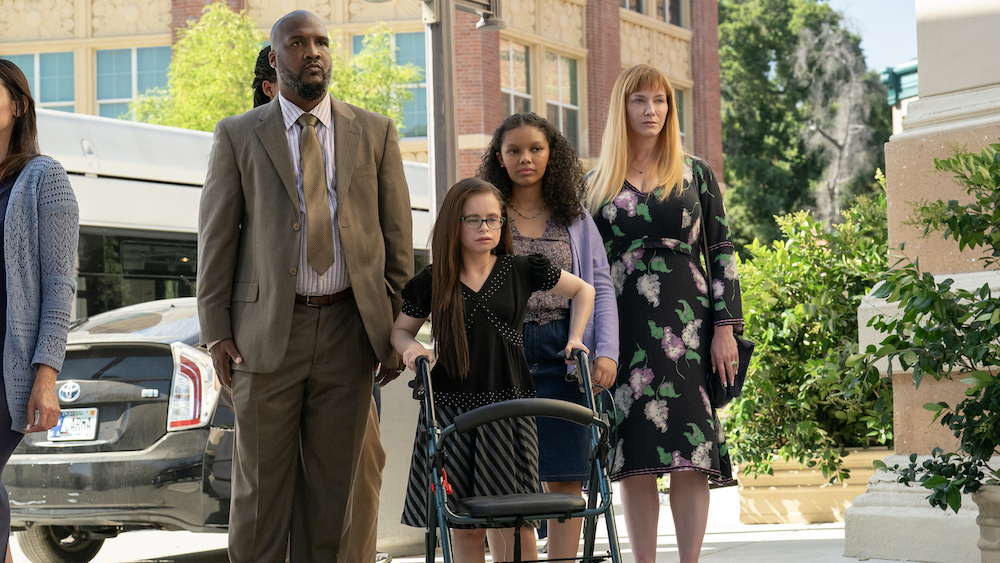
SPOILER ALERT! This post contains details from the finale of Hulu‘s Good American Family.
In the finale of Hulu’s Good American Family, Natalia Grace’s hopes that the justice system might finally prevail are squandered when the court of law becomes yet another place where her truth is not welcome.
Michael Barnett (Mark Duplass) is acquitted on all charges of child abuse, mainly because no one — including the multiple experts who examined Natalia shortly before and after she was abandoned by the Barnetts — are even allowed to refer to her as a child at all. She’s merely a “person who was born in 1989,” and therefore the statute of limitations on such abuse exclude much of her time with the Barnetts and, therefore, making any evidence from that time (including some pretty damning Facebook messages) inadmissible.
But, as frustrated as viewers might be, showrunners Katie Robbins and Sarah Sutherland also hope that the finale of the limited series will prompt some introspection, as it did for them when they were crafting the story.
“You have to be able to get very vulnerable to get to the heart of a thing. I think that the thing that, just as a collaborator, Katie and I were able to do, that is really rare, is to be able to see each other’s fallacies and talk about them gently, but without sort of complete fear of offending,” Sutherland said. “There is a way to do that, and I know that there’s a way to do that, because I feel like we were able to do that with each other in the creative process.”
In the interview below, Robbins and Sutherland took a deep dive with Deadline into the final episode, explaining where the show leaves each of its main characters and how admitting wrongdoing can be a powerful, necessary step toward healing.

DEADLINE: Considering this story is still ongoing, what made you decide to end it here?
KATIE ROBBINS: It’s twofold. I mean, one is that the story just continues. So, as with any kind of story based on real events, you do have to pick a place to end it. But I think even more than that, this chapter of this story is so focused on something that I think maybe we touched on the last time we were talking, which is this idea that, in a show that deals with some tropes of horror, like these moments of a girl at the foot of a bed with a knife and poison, in a show that deals that flirts with the horror genre, the thing that is the scariest and that we really want to leave our audience with is that this is a case that actually had some empirical facts. The empirical facts around Natalia is genetic age, and that that, at the end of the day, did not matter in the court of law, is something that is terrifying and should concern us all in terms of our justice system. So the place where we ended, having that land so fully on Natalia and the people who care about her, felt like the way to drive that home in the most impactful way.
DEADLINE: By the end of this episode, I felt incredibly frustrated for Natalia, which is basically a complete 180 from how I felt in the first few episodes. How did you focus on making that emotional and tonal shift land, to get to the point by the finale where the audience has started to really care about Natalia?
SARAH SUTHERLAND: We agree that it is a very frustrating and it’s part of the challenge of writing, how to land the story without making something up that’s not true. The real question we all want to know is, why did this happen? We’re never going to get a clear cut answer of that, but I do think, in the end, it feels clear. One answer that feels really clear is that this [would have] never happened if it had not been for Natalia’s disability. We talked a lot about wanting to really land the role of bias here, both from the Barnetts, but also the system and the press and most of us watching, also, who like the people interacting with the news of it in the beginning, we are, together, guilty of, at some point, believing that Natalia was an adult in a way that never would have believed if it had not been for her disability and her otherness. The U.S. passport has confirmed her age. That was an empirical fact. She was a child. There was an empirical fact before the trials took place, but because of the fact that the Barnetts had re-aged her, she was not able to be treated as a child in court.
I just think it’s really fascinating, just how devastating is it was, not only that they couldn’t bring up the fact that she was a child, but because she was legally an adult, there were statute of limitations on what time period they could even be looking at the crime. The time period was specifically after she had already moved in with the Manses. So legally, the mission for finding justice was so incredibly impossible in this way that feels completely baffling when you look at the facts. But, yeah, that’s a very meandering way to say, I think keeping that in mind as we’re trying to figure out which things to include, and which things not to, and which parts to speed up and not…there’s a ton of story wrapped up in Episodes 7 and 8, but [we wanted to] really land that notion that at the end of the day, this would never have happened had it not been for Natalia’s disability and for the kind of intense discrimination that is true for people with disabilities in this country.
ROBBINS: To kind of go back to the initial question that you were asking in terms of the way that it gets set up for Natalia in those first four episodes, and having an emotional response to her in the back half of the season, I think that that in those first four episodes, obviously, we’re seeing her through Kristine and Michael’s perspective and the allegations that they were making about her. Once we flip and are suddenly living with her on her own as a character…suddenly we are with her as an emotional person, as opposed to the object of fear and only seeing her through the lens of other people. So I think as soon as you start to live with that, then you start to have these questions about why and how this could have happened. The work of making us as an audience lean in and care about her happens simply by seeing her as a person in those later episodes.
DEADLINE: In this episode, Natalia and Michael have a conversation after the trial where she really tries to make him see how complicit he was in what happened to her. What’s your take on that moment? Is Michael, at least the show’s version of him, ever really equipped to understand the weight of what he allowed to happen to her when she was a child?
ROBBINS: I think that it sort of happens in small bursts for our version of Michael, for the character that that we created with Mark. I think that you get a whiff of it in those early scenes in Episode 8, when they’re starting to go through all of the evidence, and he’s starting to be like, ‘Wait, I don’t understand. Why don’t we have more people who are willing to speak for us?’ Then he and Kristine have this big fight in the guest bedroom of Val’s house, and he starts to have a panic attack, because he’s realizing, ‘Holy sh*t’ about what it all adds up to be and what it all adds up to mean about him as a person. So he lets that in for a second, has a panic attack, and then kind of pushes it away again, and then he gets off, and then he has this interaction with Natalia outside of his house. I think he does have these little tiny bursts of it, but he does sort of what we all do, right? In everybody’s version of telling their lives, we kind of cast ourselves as a hero, and we always try, often, to justify our actions. Like, we were doing it because we were told to. We were doing it because we were trying to keep somebody else safe.
I think that people make excuses for ourselves because it’s so hard to let in any kind of admission of any wrongdoing. So I think that he, in our version of the story, in those scenes, he is coming up with excuses. He’s coming up with justifications for why he did [what he did]. He’s painting him and Natalia as the same. Then finally, he gets this little flicker at the very end…he looks back at that initial photo that he got of Natalia all the way back in the pilot of this little girl that he sort of fell in love with then. I think in that moment, he has a little bit of a reckoning, but it’s small, and it’s with himself, and I don’t think it offers him a tremendous amount of relief or catharsis.
DEADLINE: How did you come to find nuance in Kristine? We see things from her perspective for four episodes, but even when the show shifts to Natalia’s point of view, it’s not like the show just paints Kristine as this evil woman. There’s still a complexity there to how she contends with what happened to her and to Natalia.
ROBBINS: For me, the most emotionally impactful moment for Kristine in this episode comes in that moment with Jacob, where he says, about about the speech that Christine has been giving…about how doctors told her to give up on him as a child, that he was never going to speak or tie his shoe or tell her that he loved her, and that she wouldn’t give up and she fought, and that that is exactly what Natalia’s birth mother was told about Natalia. She can’t hear that at first, and then eventually Michael doesn’t want to see her, Val doesn’t want to see her, Jacob doesn’t want to see her. She’s all alone. She goes back to her mother’s house, who she has earlier in Episode 4 said because her mother wasn’t willing to admit to the demons in her life, she ended up all alone. Now Kristine is going there to be with her mom. She’s kind of ending up like her mom, all alone, without her children, without her husband. She then goes and she watches the video of of Anna, of Natalia’s birth mother, talking about her and talking about what she was she was told to do with Natalia as a baby — just to give her up because it would be too painful to try to raise a child like Natalia. I think that, if there is a moment of grace for Kristine, it is in that moment. Because I think that love for Jacob is real and and true, and her entire identity is wrapped up in the work that she did with him as a young child. So hearing that from the mouth of another mother, and recognizing herself in that other mother, I think she also has this little, tiny moment of realization in our version of the story, and then again, it’s too painful, and she closes the computer.
SUTHERLAND: The question of, does Christine know what she did or has she convinced herself to such a degree that she doesn’t…we don’t have any record of her ever acknowledging that she understands. So, we can’t put something there that hasn’t been stated. What’s interesting about this story is not that this is about some extraordinarily evil people. I don’t know. We can’t say. We’ve not met them. I can’t speak to that. But it’s a story about how seemingly ordinary people can very easily do extraordinarily evil things, and I think that the ripple effects of that on this story have been so extraordinary and also have such interesting echoes to the rest of the world. So I think, in terms of a creative choice that’s more interesting, and then just in terms of a human choice, it feels more true to the people that we know in our real lives. People who do terrible things don’t think of themselves as doing terrible things.
DEADLINE: To your point, we are at a moment in time where the truth doesn’t seem to matter as much as it used to. People are not getting the due process they are owed, and we have seen many instances of the justice system failing people recently. How have you reflected on the story you set out to tell several years ago, which now only feels even more relevant and poignant?
ROBBINS: We talked about it a lot, even in the room, even as we were writing, because we could see some of the the writing on the wall in terms of where we were headed, and it has just become more acute, the ways in which the justice system can be manipulated and can have these great failings. I think that one of the things that I take some comfort in and hope in is — in these last few weeks since Episode 5 came out and in watching the response to that episode — it is so unusual for people to make a judgment about a person or an idea and then vocally speak to the fact that they’ve changed their minds and that they were wrong, and that they feel badly about being wrong and also examining why they were wrong. I’ve been looking to see how people have been responding. There have been so many people in a somewhat like public forum being like, ‘Oh gosh, I went along with this version of the story that I was being told, and I didn’t ask a lot of questions, and I feel really badly about about that, and I’m horrified that me not asking these questions was kind of writ large within the justice system. What can we do about that?’ I’ve seen people being like, ‘What do we do for Natalia? How do we fix this?’ I think that that feeling of indignation and of unfairness in people is what we need and is meaningful and can spur action. I think that we always look to be telling stories that have a reason to be told. This one already felt like it had a reason to be told when we were working on it. It’s exciting to hear that you’re drawing those connections between watching it and what we’re seeing in the world, and I guess I hope others will as well.
SUTHERLAND: In that scene between Kristine and Val, Val is a surrogate for the audience in many ways, where she goes on that journey of first being enthralled by Kristine and thinking everything she’s saying and what she’s doing and the saint that she’s presenting herself as is so extraordinary. Then becoming so close with her that she’s invited her into her home, and to have somebody who becomes a close friend of someone and then slowly starts to realize that they were wrong and to be able to admit it…I love that scene, and I love the way [Sarayu Blue] played that, because it felt like an example that you can change your mind. It is hard, but it’s a very human and necessary thing.
