

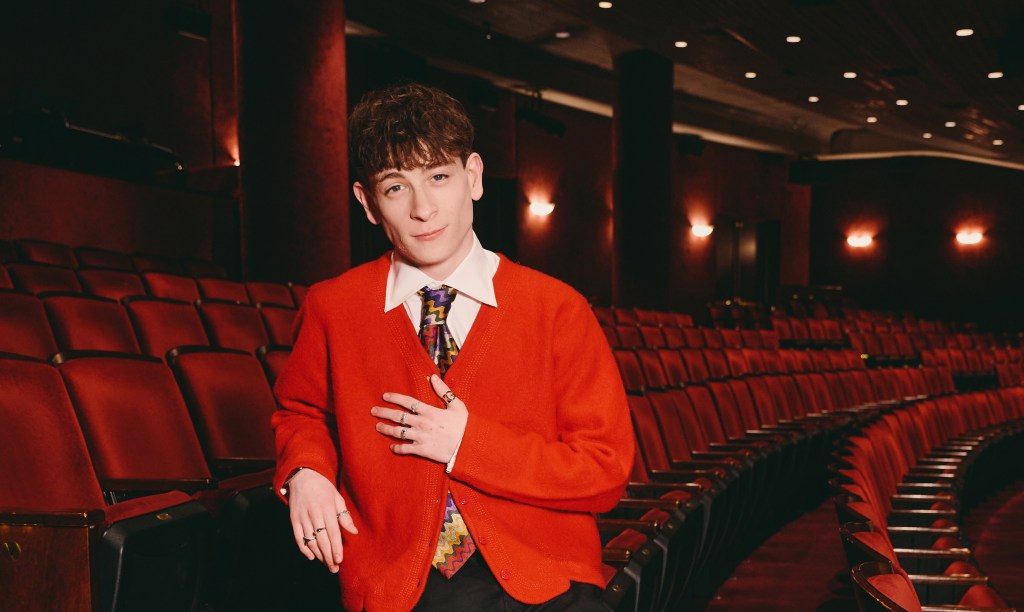
Louis – he pronounces it Louie – McCartney had only recently learned the name of the young actor who, 28 years before McCartney was born in Nothern Ireland, won the Tony Award for Best Actor in a Play. “It was something ‘First,’” McCartney tells me, and, prompted, I say Firth. Peter Firth, for Equus.
“Yes,” McCartney responds excitedly. “Peter Firth, 1975!”
Now, 50 years after Firth’s historic win, McCartney is up for the same award at the same age for his powerful, funny and terrifying performance in Stranger Things: The First Shadow. A newcomer to the stage, McCartney, a strikingly quirky looking young man gives him just the slightest resemblance to a Beatle with whom he doesn’t share a name – the young Ringo Starr.
McCartney’s unassuming looks are perfect for Henry Creel, the lead role and major driver of the spooky and even horrific action of the stage play that serves as the prequel, or origin story, of the wildly popular Netflix supernatural thriller Stranger Things.
When McCartney arrives on stage – by which point the audience has already experiences some pretty nasty doings – his young Henry a shy, nerdy but somehow vaguely threatening high school kid. Soon enough all sorts of things chilling and violent will happen to and because of Henry. Fans of the Netflix series know from the moment he first mentions his name – the words “Henry Creel” draw an audible gasp from an audience that already knows the goofy little kid we see before us will eventually morph into Vecna, the sadistic, humanoid killer from the Upside Down who over the decades will bring all sorts of bad trouble to the children of Hawkins, Indiana.

T.R. Knight (Victor Creel), Louis McCartney (Henry Creel) and Rosie Benton (Virginia Creel)
Matthew Murphy and Evan Zimmerman
McCartney knew about Creel and Vecna and other stranger things when he won the roll two years ago for the play’s West End debut. What he didn’t know much about, or anything really, was how to act on stage. Stephen Daldry, the play’s co-director (with Justin Martin), told Deadline’s Baz Bamigboye international correspondent last year about recognizing something in McCartney from their first meeting at an audition. “It’s in his bones,” the director of Billy Elliot and The Crown said then. Calling McCartney “a proper theatre animal” despite having never performed on stage prior to The First Shadow, Daldry’s instincts paid off. Praised by critics – even those few who were otherwise unmoved by the play itself – McCartney carries the action- and special effects-paced thriller on his slight shoulders from beginning to end.
The play was written by Kate Trefry from a story herself, Matt & Ross Duffer, and Jack Thorne, and McCartney’s involvement, acclaim and quick rise to fame from a place of inexperience calls to mind that other out-of-nowhere acting phenomenon in a Jack Thorne creation currently topping the Netflix charts and dominating the thoughts and conversations of TV views: Adolescence, with its young star Owen Cooper as another seemingly and conflicted mild-mannered boy who harbors a vicious killer deep within himself.
“He came and watched us!,” McCartney said of Cooper’s attendance at The First Shadow with a burst of enthusiasm that seems to mark the 21-year-old stage newcomer’s entire experience on stage and, certainly, in the few weeks since the announcement came that would place him in contention to make Tony Award history.
This interview has been edited and condense for length and clarity.
McCartney in ‘Stranger Things: The First Shadow’
Matthew Murphy and Evan Zimmerman
DEADLINE: So, at 21 you’re the youngest Tony nominee ever, right?
LOUIS MCCARTNEY: Tied youngest with, oh god who was it? I think something First?
DEADLINE: Firth. Peter Firth.
MCCARTNEY: Yes! Peter Firth in 1975.
DEADLINE: That must feel a little bit overwhelming, to say the least.
MCCARTNEY: I mean, it’s like, it’s something you read in the history books, you know, to be tied along with that particular nomination he got back in 1975. To be honest it’s bloody surreal. Because, I don’t know if you know it or not, but I trained on the screen and I had no idea what theater was or if it was even an avenue or, you know, who the hell does it?
And I’ve come into this world and realized, you know, it probably takes more balls and more muscle than anything in the world and you know you’ve got to be really strong to compete. And then to be honored with that kind of title after doing and loving this show, it’s just a really cool pat on the back, you know? And also a bit of Broadway history I didn’t even know about.
DEADLINE: You’re very good in the show. I keep thinking of the show called Adolescence on Netflix [written by Stranger Things: The First Shadow playwright Jack Thorne].
MCCARTNEY: Oh, dude, yeah.
DEADLINE: This kid seemingly from like nowhere, no professional background, and he just explodes.
MCCARTNEY: Owen Cooper.
DEADLINE: And now we have two of you and both both from the UK. I believe he’s from the Liverpool area, and you’re from Belfast, yeah?
MCCARTNEY: Yeah, Northern Ireland.
DEADLINE: What’s in the water? Two young men with no experience in the fields that make them famous, and suddenly you’re both being hailed and honored for these amazing debut performances. Whatever it is, you two should definitely get together and have a hangout at some point. Compare notes.
MCCARTNEY: He came and watched our show! He’s so talented at such a young age and he’s only like 15, 16. He was so jetlagged, god love him, that he had to run home. He was like ‘I’m falling apart.’ I would love to have said hi, but you know I was literally in the taxi when someone came and told us he came and watched us. He said he thought it was great.
DEADLINE: Very cool. Okay, so now let’s back up a little bit. Tell me how you got the role of Henry Creel?
MCCARTNEY: I love that question. Yeah, so I got the role through, I got this self-tape one day and you know I had just been auditioning, auditioning and it said “untitled Netflix drama.” It’s a play directed by Stephen Daldry and that’s all I had to go on. The beautiful thing about this self-tape is that it carried me through the run. Because it had this brief in it, this character brief about this kid named George, the cover name for Henry Creel at the time, and it was about this kid who was desperate for connection, and was savagely loyal, and is living in the spirit of the boy he once was.
McCartney
Matthew Murphy and Evan Zimmerman
And these things that, you know, you think in a character brief that are quite undefined or maybe they don’t explore that much and you don’t find a lot, but dude these words that they wrote for me I have used those for, you know, the last two years. And then I auditioned, auditioned, and I got called to London, and I was in this big room with like 30 kids. And Chris Buckley was actually in that room, he was auditioning for Henry as well, but he got Bob [on the West End]. I kept coming back and they had me flying to and from and to and from and every day felt like a step closer, but also a million miles away because you never know with these things, and I simply had no idea.
We were asking questions. We were being cheeky like, hey, you know what’s going on? And they just, you know, big shrugs and smiles. You know, it was like, hey, just coming back and I guess that’s a good sign, but also incredibly nerve-wracking, to be honest every time you go back it’s an opportunity to fuck up and you just can’t, and you’ve got to just go again. It’s sort of brutal. It’s like, okay, I nailed that one, now I have to do that again and again. And then, hey, after like three-ish months of auditions, you know, I got into the workshops, which was a six week kind of program for the production where they were putting actors on their feet and you know really testing the story and seeing what worked and whatnot. And in that room was pretty much everybody in the original cast and one by one they all got told that we got it, but we weren’t allowed to tell anybody else. It was a bit like Hunger Games and we were all tributes fighting, but it was a very cool experience, very weird and once in a lifetime.
DEADLINE: What were they looking for in you?
MCCARTNEY: That’s a great question too. I love it. So, what they were looking for, right, is when they were casting the Henrys they find these kids where one of them could do the psychopath and chill your bones, and the other one could warm your heart, but neither could do both. You know, there was no one that could ride the line and they were just looking for somebody who could just kind of switch between the killer and the human. And I would say I really enjoy the scary moments, and it was a journey for me throughout last year to be okay with being vulnerable and showing people the nerdy side of Henry and making myself look like a fool.
What they saw was they knew “he’s a nice guy, you know, he’s from Belfast and he’s okay, he’s cool, but I’m not seeing this like really sweet, funny, cute nerdy side to him yet.” And they got me in this scene in the lockers, which is the scene with the radio, and it’s the first time Henry meets Patty, and that was the moment that, I don’t know, something happened and they saw what they wanted to see.
Also, the illusion boys, Jamie [Harrison] and Chris [Fisher], who worked on the show and I’ve known them for a couple of years, the creative team was talking to them about this problem of finding a kid who could do both. And the illusions team, Jamie, stood up and went, oh, we’ve been talking and you know he’s actually really funny. And they went really? Because you know when I’m in the room I’m, you know, in business mode. I’m not really myself. And so Jamie said yeah we’ve been talking to him and he’s cool. And they were like, oh, okay. And then I think that was the time that they decided to put me in the lockers scene and say, okay, let’s see it. Can he do it?
DEADLINE: That’s the scene where everything kind of explodes, right? We see a monster. Is there any particular moment where you can feel the audience, just kind of have that intake of breath, the oh my god moment?
MCCARTNEY: Oh, absolutely, dude. It is the craziest view for me when that Mind Flayer deploys and you know eats the audience and just completely takes over them like the shadow it is and you know people love it. But then there’s almost this second wave that comes after the action, where people are like screaming and they are like really into it, and it honestly gives me so much energy to go further with Henry’s psychotic nature, my you know adoration of this feeling, this feeling good. It’s like I like the death and the destruction because it’s powerful and its control, and that’s the character.
When they start to give that energy back and they’re like hitting you in the face with like come on, come on, give us more, you know, you just, you just feel yourself slip into it. Like, it’s really not hard with an audience that’s capable of throwing away the transactional nature of theater with an audience and actor. It’s just people enjoying their night and I’m like, great, ok, let’s give you some more. And in that moment there they just go holy crap.
DEADLINE: When I saw it, and this is going to sound awful in print, but the big gasp came the first time the audience saw an animal sort of, well, explode, or implode.
MCCARTNEY: Yeah, poor Prancer. That’s really a nice unexpected moment because we’re trying to tie this storyline where emotion is connected to powers and that it’s unexpected half the time, and that’s why it’s such a battle on Henry’s mind because we want the audience to feel like anything could happen. And this is an instance where anything could happen, and something does happen, and it’s incredibly bad.
Yeah, I mean, because we’ve got these like cracks, like individual beaded cracks, and you hear people go ooh, aah, aah, ooh, aah and they go through like the stages of like grief. It’s a crazy experience.
And that’s the first time anything onstage levitates.
DEADLINE: The audience knows early on that Henry comes with some baggage, to say the least. There was something that happened back home in another town, and we learn what that terrible thing was. When do you really start to convey, “this kid has some stuff and you’re going to see some other stuff?”
The Cast of ‘Stranger Things: The First Shadow’
Matthew Murphy and Evan Zimmerman
MCCARTNEY: What I have experienced is it’s all energy, right? If I’m walking onto that stage, I’ve been working on this character for so long that I have the foundation that this is a broken boy and he wants to do right in the world, and you know he wants a girlfriend, and he just wants to fit in. And you know as an actor you can play that, and then once you start to get comfortable with kind of embodying these emotions, something else comes out, which is the next nature of how a human really is, like in trauma, it’s the response that people have, it’s not clear and defined.
So if I’m playing somebody that’s had this brutal thing happen to them, you know, it’s underlying and I don’t want to show them too much too quick because the arc of the character in The First Shadow, I mean, it’s insane. If you compare the first time I’m on stage and the last time I’m on stage, it is such a journey that I’m so grateful I get to do, but there has to be a reason and there has to be a method to the madness. And that means that when I’m conveying emotion or vulnerability it’s all metered, and it’s the brilliance of [co-directors] Justin Martin and Stephen Daldry in showcasing that dichotomy between humanity and wrath and violence and it’s a character who’s plagued by all of it.
So really you’re playing the strain all the time and that’s what’s exciting because it’s conflict. And Stranger Things is about a conflict and people making decisions and every single time Henry is on stage he has a decision to make. And I think it’s very important that people understand that, that he is a wire’s edge away from losing his mind, but he doesn’t, but then he does, but then he doesn’t. And you know we just play with you guys and we just go back and forth.
DEADLINE: Are you able to tell by audience reactions about how many of them get the references to the TV series? Can you tell who the Stranger Things people are in the audience?
MCCARTNEY: I think over 65 percent of our audience is first time theater goers, which means that they are from the Stranger Things fan base, and we’ve got this huge welcoming arm of people who love the show, who love the characters. And you know we’ve got lore in our play, so they want to see where the story goes. So, they would know the characters, but sometimes you get people that just enjoy theater and they don’t know the characters or the lore. But it is a prequel and I truly believe that you absolutely don’t need to see the TV show because our play is very Greek. It’s a Greek tragedy about a fallen hero and you know you’ve got the archetypes, you’ve got the mother, you’ve got the love interest, you’ve got the antagonist of Dr. Brenner, and you’ve got the otherworldly aspect of it like in Hamlet when he’s, you know, pondering suicide and it’s very up to the stars. And that translation to our play would be the Mind Flayer, the big monster, the thing that pulls all the strings. I think it’s really interesting in the play that there are points in the story where the story kind of ends and it seems to have a definitive stop point, but then something happens.
DEADLINE: They really put you through the wringer physically on this. What do you think is physically the most difficult feat you have to perform on stage? And what’s it like to be levitated?
MCCARTNEY: It’s cool, man. The weirdest thing is that when we’re rehearsing it and I don’t have the blindfold on it’s just very normal. I know I’m being lifted and I can almost feel my weight transferring. But when I have that blindfold on, it literally feels like I’m in space because there’s nothing for my brain to make sense of. It’s a really, really weird experience and it doesn’t stop. I have literally thought about it and been like, okay, that’s weird, and then it happens again the next night. So, I get that, which is nice, but also, I mean, I don’t really feel anything, like it’s very smooth and you know they’ve made it like, you know, butter.
You know, it’s like you’re not supposed to really see anything happening and it’s just quite sudden. But yeah, it was actually quite hard to learn. You’ve got to engage your core and stuff. There’s a bit of bodywork sort of with it as well, which is really cool, because you don’t want to swing. You’re not necessarily fixed to a point, your weight is just being lifted upwards, and it’s your job to kind of, you know like in zero-G, like keep yourself still and not float away.
DEADLINE: What other parts do you find the most taxing of the show?
MCCARTNEY: There’s a bit in the show, and this is not the bit you think, but there’s a bit in the show where Henry has a sort of epileptic Stranger Things seizure and we actually worked on the movement and stuff so it looks like something terrible is happening and this boy is going through so much, but really I’m kind of just chilling and you know listening out for a story beat. The bit that’s the most taxing because it’s fueled by absolute rage and betrayal is called the Brenner Breakup, and it’s the moment where, I can’t really talk about this, but it’s the moment where something bad happens in the lab and a lot of people go flying with Henry’s powers. It’s very animalistic and I can’t escape the human nature of it. Like, it’s not really acting at that point it’s me just like going mental and actually wanting to hurt these people. And to show that, it’s not like I’m “oh I hate you so much.” It’s like “I want to kill you because the Mind Flayer wants me to and that will make me stronger.”
And I’ve got to translate that to people and sometimes I am really pooped by the end of it. But it’s worth it because the reactions, you know, the oohs and the ahhs and the groans when I put that guys blood in my mouth and you know all that stuff, I really enjoy. That’s sort of the payoff.
‘Stranger Things: The First Shadow’
Matthew Murphy and Evan Zimmerman
DEADLINE: What do you think you’ve learned the most about this whole experience? And from whom?
MCCARTNEY: Well, I’ve learned not to chase performances. Certainly, you know, I messed up in London like the first couple of weeks and started chasing nights that you know were long gone, just realizing that the moment is the moment in live theater and being okay with messing up is totally fine because you know it’s not really that big of a deal. You know, it’s like if you’re having fun you can just move on, like you don’t have to kill yourself over a bad performance because it wasn’t like last night’s. But yeah.
DEADLINE: That’s what’s meant by chasing a performance?
MCCARTNEY: There are bits in the story where you know what the standard reaction is, and that the little niche things that make theater fun where somebody absolutely guffaws or sneezes and almost makes you break on stage. But if I think that’s going to happen, it will detach me from the moment and I just won’t be doing my job then. My job is to be there, and to tell a story and to believe it myself, and use my imagination and give my everything to it. But if I’m giving everything to 24 hours ago, then there’s a disconnect. It’s like I’m not there with you.
DEADLINE: Tell me about your anticipation for Tony night. What do you expect to be doing to get ready for the day?
MCCARTNEY: To be honest, I had no idea it was even possible. But hopefully, I mean, I think I have a show that day. I think I have a double that day, so I don’t know what’s going on. But hopefully in the morning, I’ll be maybe enjoying a nonalcoholic mimosa. I’ll be hanging out with my beautiful girlfriend and my agent will be coming over, so we’ll all just be getting ready and having a good time and you know staying positive, but not expecting anything. Because you know it’s like what will happen will happen and I don’t really get fixated on it. But we’re all human and everybody loves accolades and awards and stuff.
Because, I mean, I know it’s the classic thing of like, you know, do it for the art and not for the award, but then part of you like the pat on the back because it’s such a nice nod. It’s like you’re human and you know talking about throwing away ego and all that, but it’s like of course I have an ego, even though I try to keep it, you know, low because it’s unhealthy. So, I won’t be expecting anything. I’ll just be enjoying myself because I’m going to the fricking Tony’s, and I’m 21 and what an opportunity. I’m happy and that’s the main thing, you know?
