

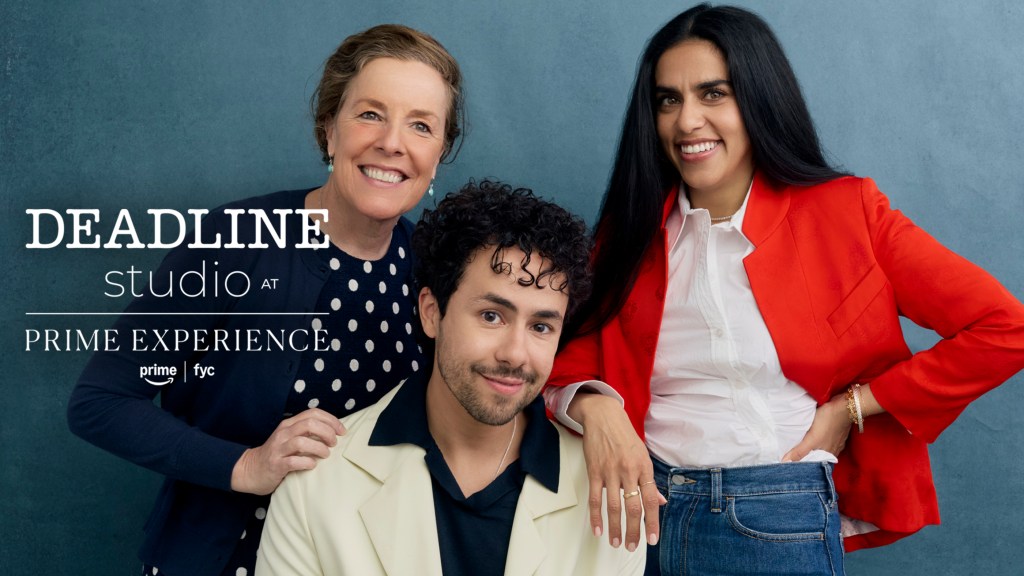
For his first foray into animation, Ramy Youssef taps into stories from his own middle-school years for Prime Video’s #1 Happy Family USA.
“I had all these stories from this period of time that felt really unexplored,” says Youssef during a conversation for Deadline Studio at Prime Experience. “I looked back and thought, ‘Oh, this is crazy. And it’s so crazy that it should be animated.’”
Youssef, who co-created the show and voices the main character Rumi, was joined in the discussion by co-creator Pam Brady and art director Mona Chalabi.
Watch the conversation here and scroll down for photos from the event.
Set in the early 2000s, #1 Happy Family USA follows the Hussein family, Muslim-Americans who must learn to code-switch and adapt to new political circumstances after 9/11.
“[The story] was just so suited for animation, and it appealed to us that it was a way to talk about where we are now, without being ham-fisted, politically,” says Brady, who found the story an opportunity to comment on “where we are now, without talking about where we are.”
One of the main reasons the series is animated comes from the idea of the family code-switching when they leave the house. “We were really into this idea of how the doorway to your front yard would be this portal, and then it became about what’s this portal style that makes it look right,” says Youssef. “And we tried so many different things, and I think we landed on wanting it to look and feel a little bit like dial-up internet.”


Pam Brady at the Deadline Hollywood Portrait Studio at Prime Experience 2025 on May 12, 2025 in Los Angeles, California.
Anthony Avellano for Deadline

Ramy Youssef at the Deadline Hollywood Portrait Studio at Prime Experience 2025 on May 12, 2025 in Los Angeles, California.
Anthony Avellano for Deadline

Mona Chalabi at the Deadline Hollywood Portrait Studio at Prime Experience 2025 on May 12, 2025 in Los Angeles, California.
Anthony Avellano for Deadline
In keeping with the era, Chalabi says the animation for the code-switch came after the team heard multiple ‘code-switch sounds’, with the dial-up sound being closest to her vision for the experience. “It was also trying to learn the exact emotional register of it feeling like a frustrating experience, but not physically painful,” she says. “There were types of animation that looked like the characters were actually in like agony, which also felt like too much.”
Although the series follows a Muslim-American family code-switching for personal and political reasons, Youssef says the focus on that aspect made the experience universal.
“Everybody has that code-switch, everyone has that threshold that they cross and then suddenly they do something different to present themselves to the world,” he says. “I think that’s the entry point that makes the show so inviting for people who have never even heard any Arabic before in their life. It’s about that emotional experience of who you are at home and who you think you have to be, and all those gaps in the middle.”
