

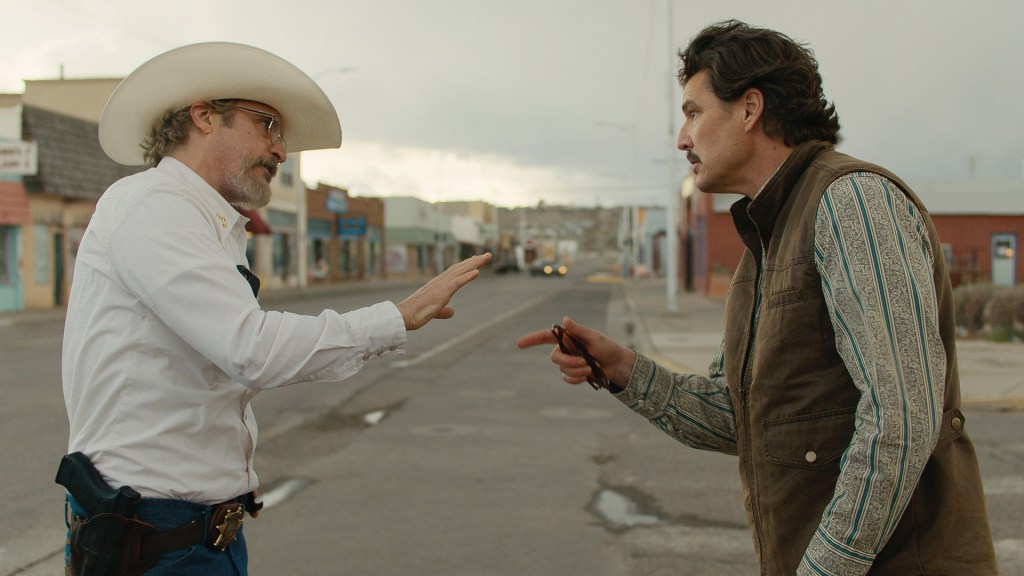
How do you make a satirical movie about modern America when the news that comes out of there every day is quite literally beyond a joke? Ari Aster is one of the rare directors willing to go there, and his new film Eddington is extraordinary not only for that but for depicting a slice of history that we have yet to see properly shown on film, even though it happened only five years ago. Dressed up as a neo-noir western, this pandemic saga drips with the kind of biting, dark political humor hardly much seen since the heyday of screenwriter and novelist Terry Southern, author of Stanley Kubrick’s Dr. Strangelove.
The setting— late May 2020—is crucial: Covid-19 has just become a thing, and the residents of Eddington in Sevilla County are getting used to life with masks and social distancing. Most comply, but others are skeptical, including sheriff Joe Cross (Joaquin Phoenix), who, in the film’s opening scenes, is pulled up by cops from the neighboring district of Santa Lupe Pueblo. Cross is a maverick cop, but one with a good heart; instead of enforcing the law, he subverts it, letting the locals get away with minor infractions, on the grounds that the town is tiny and the virus won’t be getting there anytime soon.
His views collide with those of the town’s mayor Ted Garcia (Pedro Pascal), a local bar owner who briefly dated Joe’s wife Louise, now recovering from a nervous breakdown. Her rehabilitation is going slowly, not helped by the fact that her mother Dawn (Deidre O’Connell) is staying with them and shows no signs of leaving. Dawn is a conspiracy nut and, as such, has been “doing her own research” into the genesis of the pandemic. This, though, is just the thin end of the wedge; Dawn spreads all kinds of misinformation in the town, from the speculation that the wrong boat sank instead of the Titanic to the fact that Hillary Clinton has been arrested and is already languishing in Gitmo.
In this respect, the subtext of Eddington is that the devil will find work for idle hands to do. In ordinary times, the likes of Dawn would be dismissed as crackpots, but in pandemic limbo, with everyone bored and at a loose end, her weird suppositions start to get traction, sending everyone down internet rabbit holes. She even gets to Joe—who took over the role of sheriff after Louise’s father died seven years before—when Dawn taunts the pair of them over the breakfast table. “Where’s your anger, Lou?” she says. “Where’s your anger, Joe?”
Joe’s anger isn’t immediately apparent, but it does prompt him to stand for mayor against Garcia, a move he announces over social media. This piques Garcia’s concern, and the pair meet for a High Noon-style showdown scored with a suitably western sting courtesy of composer Daniel Pemberton. Affronted by what he sees as Garcia’s condescension, Joe doubles down on his bid for mayor and turns his squad car into a campaign vehicle, complete with anti-lockdown signs with slogans that say, for one example, “Your (sic) being manipulated.”
The outside world, meanwhile, is about to boil over with its myriad lockdown frustrations, and, in a very bold gambit, Aster uses the real-life killing of George Floyd as the catalyst that brings bitter chaos to the middle of nowhere. The local college kids form their own branch of Black Lives Matter and stage a protest, which Joe does his best to tamp down in his so far perfectly serviceable way (he is, after all the kind of man who says “super-duper thank you very much”). But the rebellion is real, and it starts to dawn on Joe that the regular tools of small-town politicking are woefully inadequate in this strange new world, where news spreads more like a malignant virus than wildfire.
Although less divisive than Aster’s last film, Beau Is Afraid, Eddington is certainly going to divide audiences with its ambitious mix of genres—without spoiling the first of several shocking twists, he pivots midway from gentle western pastiche to bloody neo-noir, with a middle section that resembles the stylish early ’90s westerns of American director John Dahl. But more explosive is its approach to American politics; from Bitcoin to Pizzagate, Tiktok to vaccine denial, Eddington takes aim at all the quirks and absurdities of President Trump’s administration and how its compliant MAGA zealots have radicalized whole generations of a country once known for its compassion.
At the film’s first screening in Cannes, the largely international audience seemed nonplussed with its blending of fiction and reality, not quite grasping the significance of the references that pepper the screen, from Dr. Fauci to George Soros, Kyle Rittenhouse and, god save us all, even Marjorie Taylor Green. But though all its parts don’t quite knit together, Eddington is what you might call a big swing, a film that’s more serious than it first seems, seeing Covid as the Big Bang that landed us right where we are now. It’s about the elephant in the room: the emergent likes of QAnon, 4Chan and the Proud Boys, things that did more damage than Covid ever did, leaving a raw, still-festering wound. Without ceremony or mercy, Eddington rips the Band-Aid off, and not everyone is going to want to look at, or think about, what’s there underneath it.
