

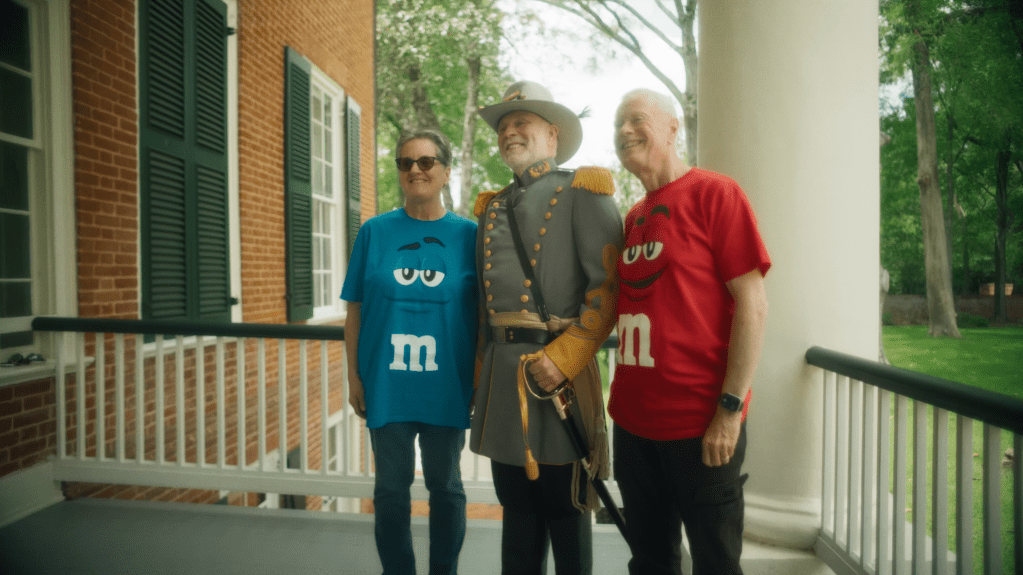
EXCLUSIVE: Oscilloscope Laboratories has acquired U.S. distribution rights to Natchez, an expected Oscar contender that won the Best Documentary Feature Award at this year’s Tribeca Festival.
Suzannah Herbert (Wrestle) produced and directed the film set in Natchez, Miss., a historic town that has become a tourist magnet for its well-preserved and stately antebellum homes. Herbert captures remarkable scenes of white visitors indulging in nostalgia for the Confederacy blithely unaware, seemingly, of the violence and inhumanity of the pre-Civil War era when millions of African Americans were enslaved. Black townspeople and visitors to Natchez cast a warier eye on the spectacle of romanticizing this time in American history.
The acquisition announcement comes just days after Pentagon chief Pete Hegseth announced his intention to restore a Confederate monument to Arlington National Cemetery, a statue removed in 2023 under the Biden Administration. Similarly, the National Park Service just announced it would repair and reinstall a statue of Confederate Gen. Albert Pike in Washington, DC that was toppled during the Black Lives Matter movement in June 2020.
“Natchez tells the story of Natchez, Mississippi, a tourist destination at a cultural crossroads with searing relevance to our current moment,” Oscilloscope said in a statement. The company plans to qualify the documentary for awards consideration this year before opening it theatrically in early 2026.

Oscilloscope Laboratories
“Natchez is a mesmerizing documentary that illuminates America’s history, exposing both its beauty and ugliness,” Aaron Katz, SVP of Acquisitions from Oscilloscope, said in a statement. “We were floored by the film and Suzannah’s skillful direction, which fostered a vulnerability in her subjects that is eye-opening and profoundly impactful. It is no surprise that it keeps winning awards at major film festivals. We are excited to release this film and continue to spark a meaningful dialogue with audiences.”
In addition to the top prize at Tribeca, Natchez won a Special Jury Mention for Editing in a Documentary Feature at Tribeca, recognizing the work of Pablo Proenza, and a Special Jury Mention for Cinematography in a Documentary Feature, honoring the work of Noah Collier. Collier also won a Special Jury Mention for his Natchez cinematography at the Oak Cliff Film Festival in Dallas.
(L-R) Editor Pablo Proenza, producer Darcy McKinnon, director Suzannah Herbert and cinematographer Noah Collier attend the 2025 Tribeca Festival Awards on June 12, 2025 in New York City.
Michael Loccisano/Getty Images for Tribeca Festival
“Natchez is both intimate and expansive in vision, and we are thrilled to partner with Oscilloscope to bring the film to a wider audience,” director Suzannah Herbert said. “After working with the team at Oscilloscope on distributing my first film Wrestle, I know they honor the care and intention put into the filmmaking. They then pour that energy into the film’s release. I’m humbled and excited that the film will get to be seen in theaters across the country because while this is a film set in the South, it’s really about the American identity.”
The film is produced by Darcy McKinnon; executive producers include Sam Pollard, Cindy Meehl, Carrie Lozano, Lois Vossen, Ted Haddock, Jacqueline Glover, Mari Nakachi, and Ruth Ann and Bill Harnisch. The acquisition deal was negotiated by Oscilloscope’s Aaron Katz and Shoshi Korman of Cinephil on behalf of the filmmakers.
Natchez screens later this month at the Middlebury New Filmmakers Film Festival in Vermont and at the Sidewalk Film Festival in Birmingham, AL. In addition to Tribeca and Oak Cliff, the documentary has screened at Sheffield DocFest in the UK, the Bentonville Film Festival in Arkansas, and DC/DOX in the nation’s capital.
DC/DOX cofounder Sky Sitney said of the film, “Herbert’s entertaining and unsettling Natchez is not just a film about a town — it’s a layered mosaic of people contending with the weight of the past in a place where the past is always present. Through vivid, often surprising portraits — like that of a charismatic preacher offering unsparing historical tours, or a woman who proudly inhabits the persona of a Southern belle — the film captures the contradictions and complexities of a community living within the shadow of its own mythology. With patience and poignancy, Natchez asks a pressing question for the South and the nation at large: how do we reckon with history when it still shapes the ground beneath our feet?”
