

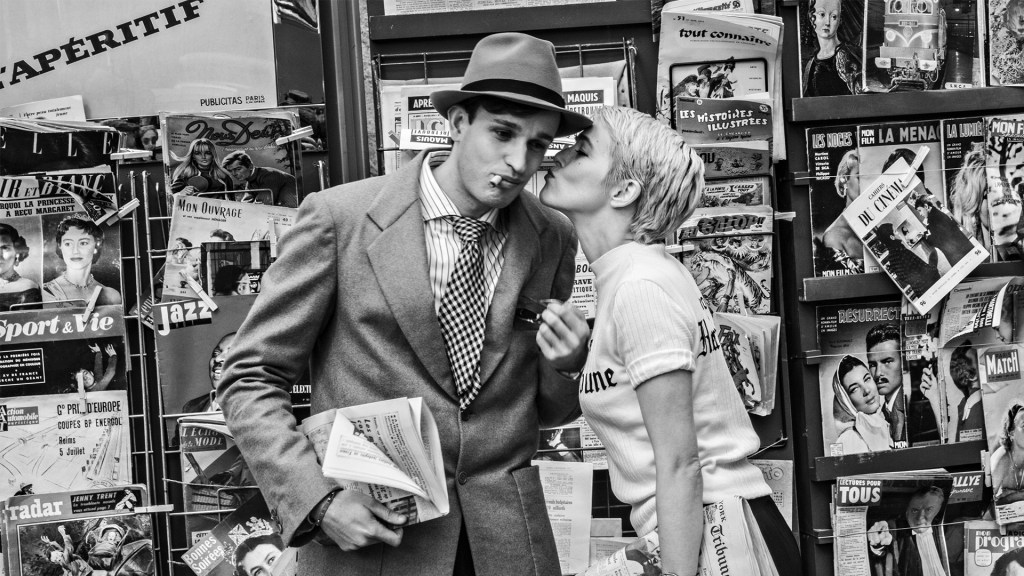

Richard Linklater is a filmmaker definitely up for a challenge. Whether it is his Before Sunset trilogy chronicling a relationship over a number of films. Or his Oscar and BAFTA winning Boyhood which followed a boy from childhood to college and filmed over a 12 year period. Or his currently in- production adaptation of the Stephen Sondheim musical, Merrily We Roll Along which tells of three friends over the course of 20 years and being shot for 20 years having started production in 2019 and should be ready for release around 2040. Ambitious? You bet. But if anyone can pull off that feat it is Linklater who tells me he has already shot about a third of the movie. “Well it is kind of top-heavy. You shoot a lot toward the end…and I say end. It’ll be the beginning in a movie that there’s more years in between the sections. But up-front you get a lot (especially) in 3 of the first 5 years,” he said of the film which stars Paul Mescal, Beanie Feldstein, and Ben Platt.
Richard Linklater at the 78th Cannes Film Festival on May 18, 2025 in Cannes, France.
Sebastien Nogier/Pool/Getty Images
I learned that recently when I interviewed Linklater for the American launch of his latest film, Nouvelle Vague which premiered to much acclaim and a big standing ovation in Cannes in May. Netflix picked it up and will release in select US theatres October 31st and on Netflix in the US on November 14th. It is a film that reimagines the making of Jean-Luc Godards’s 1959 New Wave classic, Breathless (French title: a Bout de Souffle) which starred a young Jean Paul Belmondo and Jean Seberg. It is an exploration of the youthful rebellion and creative game changer that defined the French New Wave and a legion of filmmakers who came out of it. As I said in my review it is “a movie that will make you fall in love with movies all over again”. Linklater is about to set out with this film, as well his other 2025 release, Blue Moon which stars Ethan Hawke as famed composer Lorenz Hart, on the Fall film festival circuit. It is a busy time for this multi-talented filmmaker who never seems to stop.
‘Nouvelle Vague’
Goodfellas
But Nouvelle Vague is an idea he has been toying with making for over a decade and finally did. He shot it with an all French crew and did it much the way Godard shot the film this is all about. Certainly its reception in Cannes proved the French approve, even having an American director take on one of their icons and most famous films. It is something Linklater made his own. And as one of his French producers, Michèle Pétin (Halberstadt). can attest, they were in good hands. “There is a reason why it works. The fact that Linklater is an American makes his approach to Godard different. It’s not his culture, his langage. He can be cheeky and respectful, he can admire him while still being irreverent,” she tells me. “He just looks at him from a different angle. He’s totally free in his approach. I always compare this to Milos Forman directing Hair. What story could be more American ? Yet it took a foreigner to look at America with piercing, open eyes. Linklater looks at the French 1959 youth as he looks at the American youth in his previous films, with lucid yet tender eyes. In the hands of an American director, Nouvelle Vague is definitely a French film.”
(L-R) Michèle Halberstadt, Guillaume Marbeck, Zoey Deutch, Richard Linklater, Aubry Dullin and Laurent Petin attend the “Nouvelle Vague” (New Wave) red carpet at the 78th annual Cannes Film Festival at Palais des Festivals on May 17, 2025 in Cannes, France. (Photo by Gisela Schober/Getty Images)
The hope is that the French themselves will select the movie as their official entry in the upcoming International Film Oscar race which would bring Linklater right back to the Academy Awards. “It is very much my hope and it would be a logical choice. There are many reasons that make this film the ideal candidate,” she says. “It’s a film that celebrates the many ways in which Godard and his friends revolutionized cinema : how to imagine it, create it,edit it, promote it.. All these innovations are still valid today, and the film shows this. It’s a revolution in the making. Its protagonists are unaware of what they’re doing. Godard just wants to try making things differently. He has no confidence in how this will turn out. Belmondo even believes the film will never get a release. The Academy has proven its love for French films about the making of films. Day For Night, directed by François Truffaut, was the French entry and it won Best Foreign Film (as this category was called then) in 1974.”
Of course Truffaut was French. Will the selection committee accept this American in Paris as one of their own, at least as far as Nouvelle Vague is concerned? Time will tell, but Netflix plans a full blown campaign in all categories for this one which certainly will please Linklater who explains why he took this whole thing on in the first place.
DEADLINE: What was in your head in terms of wanting to make this movie, ultimately in the style of the French New Wave, but not a remake of Breathless?
RICHARD LINKLATER: It’s wild. I hadn’t really seen something like this before. You know, that usually doesn’t work. I had that challenge. I was talking to some cinephile friends, and they were saying ‘when people make a film that’s made to look like it was at the time, and that doesn’t usually doesn’t work very well’. I go, ‘yeah, it doesn’t, but it’s going to work in this case’. I told everybody this film is a Nouvelle Vague film. This film that we’re making was made in 1959, 1960…But a look and feel like that, you got to have some visual kind of rules and metaphors, you know, kind of like what it is. So, I just felt like that would be the spirit of it. Wouldn’t it look weird if it was in English, in color, or widescreen? It would just be weird.
DEADLINE: And you did this with an entirely French crew. Basically besides your star Zoey Deutch who plays American star Jean Seberg you are the only American.
LINKLATER: Yeah. It was crazy. It’s a film I wouldn’t have made earlier. I guess, with experience and age, you gain confidence, like this conceit that this idea could work, but years ago, I would’ve been crazy to do it, but sure enough the people who came aboard in France were equally fanatics, you know? Everyone, every department head, everyone cared, so much, about getting this exactly right and it meant so much to them. You know, it’s their film culture, their history. The Nouvelle Vague, obviously, is such a big thing. Maybe that’s what made me a guy who could pull this off. Like, it’s almost such a big deal there, they can’t really even do it, where I’m coming at it as a world cinema fan, you know? I was not conflicted the way a French filmmaker might be. Like, those are their fathers, some edible thing. I didn’t have that. I just Ilove the Nouvelle Vague and was inspired by it and see it the way someone from around the world saw it, just something to be inspired by.
DEADLINE: And you were thinking about this for a decade or so? Were you waiting for Godard to die before taking it on?
LINKLATER: Oh no. Actually, I tried to get it made about 10 years ago. I sent it to a few people and said ‘let’s do it, because I already kind of had Zoey Deutch in mind. I felt I had my Seberg. So, I sent it out, and people liked it, but it’s a weird thing. It’s just such an unusual thing. I don’t think they knew what to do with it, and then I was busy with other things, but it never left me.
Vince and Holly, you know, my colleagues I worked on this with, we worked on it for a long time, thought about it, and we’d kind of do new drafts, new ideas. It developed in a great way, and I really like having that gestation time. By the time I was making it, I’d made it in my head, so many times, I kind of felt it, like felt it so clearly, but I think Godard’s passing probably did help it get made in France, you know? It’s like, oh, ‘he’s gone now, yes, it’s time to do it’, maybe that did help. I never heard those exact words, but maybe it did.
DEADLINE: I have to say I thought Francois Truffaut’s movie about the making of a fictional movie, the Oscar winning Day For Night could never be topped.
LINKLATER: Well, the only thing…I loved Day For Night, like everyone else, of course, but I will say the film that’s being portrayed being made, I think we have them beat. They’re making this silly little film, Meet Pamela and we’re making A Bout de Souffle! It’s not a fair fight. I didn’t reference any old films, particularly. I just kind of felt this. It was just make it the New Wave film, but yeah, a love letter, for sure. There’s not a lot of conflict, like the usual filmmaking conflicts of money and time and a little bit of collaboration, misunderstandings, and stuff. I really told the cast you’re excited just to have this chance. It’s a great moment in time. You’re just doing your thing.
DEADLINE: And other than Zoey this is largely a cast of unknowns including Guillaume Marbeck as Godard.
LINKLATER: Well, that was an issue. You go over there, and you use a couple of name actors, and you get your French TV funding, you know? And I had to kind of win that battle. My producers loved the film. They loved the idea of it, but they were just practical, like, ‘oh, we got all these great name actors’, and I would say, ‘well, don’t you see? I got guys like Guillaume (Marbeck) and Aubry (Dullin) who played Belmondo, or Adrien (Rouyard), who played Truffaut, or Jodie (Ruth-Forest), who played (screenwriter Suzanne) Schiffman, and I have them sitting around’, and I was like ‘don’t you see how special this is? Like, it’s them. You don’t know these actors. That’s the magic’. I’m really hoping to transport you to that time. And I’m trying to turn off your critical thinker. If it’s someone you know really well, you’re going, ‘oh, they’re doing a pretty good impression. You never quite lose yourself in the movie. You’re going, ‘oh, that’s pretty good, oh, yeah, I’m believing this’, you’re judging them because you have a known person in your face, whereas I think you had the possibility of saying, ‘oh, I’m hanging out with Godard, that’s Truffaut, that’s Chabrol, that’s Cocteau, that’s Bresson. I really wanted it to feel that way.
DEADLINE: Like The Artist it is great that it is in 1:37:1 ratio, pure black and white like Godard’s film, and did you seek out actual cameras and equipment of the time being depicted?
LINKLATER: Oh, yeah. I think the key to it is old lenses. We got period lenses. It’s a combination of a lot of things, and you can achieve it. It’s just a trick. We did a lot of tests, and it was such a fun exercise. I’ve never done this before, probably never will again, to get under the hood of another movie and try to replicate the look of another time so specifically, but it was so fun…We just had a lot of fun, and it felt like making your first film. I was like I’m 28 years old, let’s put the camera here, here’s the plan. We worked kind of quickly, not as quick as they did, because we had to recreate. We couldn’t just show up on a street and shoot, the way they did. We had to create that street, but they had 20 days, we had 30. So, we had a little more.
DEADLINE: Was this period basically an inspiration for you to become a filmmaker yourself?
LINKLATER: Yeah. I think the Nouvelle Vague, to me, it always represented the personal film, or freedom, or it was that moment in time, and it’s not just France. It was the US, you know, Cassavetes, Shirley Clarke, Lionel Rogosin. There’s a lot going on in New York, England, Japan. You know, there was something going on in world cinema, late ’50s, early ’60s, that’s really inspiring, and I think France wins because it just turned out they probably had the most talented large group of really talented filmmakers.
So, yeah, to me, it just represents the notion of a new kind of film for a new era, that you could make a film that was so personal. If you think about it, most films were big stories, or genre pieces, or you know, important things, beginnings, middles, ends, and all that, and the New Wave kind of came in and said, ‘oh, you can make a whole film about a little love affair, you can make a whole film about your childhood, you can make a film about, in this case, this kind of genre-bending, Godard, what he does with this kind of typical crime film, you could say.
They brought their own originality and kind of lowered the stakes of cinema, in a way. Like, every film didn’t have to be some epic, important thing. I mean, they were in opposition to their own French cinema. They were kind of at war with it, and they made short films, and stuff, but they were critics, you know? They were writers. You can read Truffaut’s writing from the mid-50s. He’s talking about the film of the future, what it should be. So, you see these aspiring filmmakers kind of coming at it through primarily American films, and what they’re writing and excited about. So, it’s just kind of amazing that they manifested it at this time, and I don’t know. It’s forever inspiring.
DEADLINE: You appropriately premiered this in Cannes in May and it hadn’t been sold at that time to an American distributor. Many people were surprised this ultimate love letter to cinema went to Netflix, a streamer.
LINKLATER: Well, you know, it’s kind of the modern age. I don’t really have these conflicts because, well, let’s just break it down. In the modern world most people see films, it’s not 1959. it’s not 1960s. You know, how long is a black and white French-language film going to play in theaters? I don’t care how good it is. You know, it’s not going to play for five months at the Bleecker Street Theater, or whatever. So, working backwards, it is going to play in a lot of theaters. It’s going to play in LA, at theaters. It’s going to play in all the major markets.
We have 35MM prints. You know, if that means something to you, and I hope it does, I say to every cinephile out there, ‘well, just indulge yourself, and drive over, and pay your money, and watch it in the theater because that opportunity is there’. We’re showing it in my theater, in Austin, the Austin Film Society. 35 print. You know, so, everyone will have their chance. I did that. I lived in a little town, and I would drive 70 miles, to Houston, to see a film. Everything doesn’t necessarily come to your door, come right into your computer, these days. You can actually seek out experiences. So, anyway, but when it comes to who’s going to handle your film, it’s kind of the same old equation. It’s like who likes it the most. I mean, there was interest, but my French producers, bless them, they really went all out. So, they’re out a certain amount of money. So, you know, the right people handling it who’ll pay for it, it would get them out of debt, or whatever. You got to roll with it, and this’ll be my third thing with Netflix. I thought they did a good job with Hit Man. So, I’m not really conflicted about it, at all. I love Netflix because they’re great to work with. They’re so thorough, and they care, and all that.
And a film’s going to have a final resting place anyway. At least my whole film life, you know, from let’s say the early ’90s, when people come up to me and say, ‘hey, I really liked Fill in the Blank’. If I ask them ‘where did you see it?’ It’s like ‘Oh I rented it, or I streamed it’ or, if they’re of a certain age, they’re like, ‘oh, yeah, I saw it back in the day in the theater’, but it’s just not the way films live for a long time.
DEADLINE: What do you think Godard would say?
LINKLATER: Godard, of all people. I mean, maybe some of those other guys would be a little more with this kind of film purity stakes going on, but I just don’t buy it. You know, Godard was the ultimate early adopter. I mean, he was shooting video in the 1970s, every new gadget, every new means. He would be shooting on a phone, now. He wouldn’t have any problem with that. He made a lot of stuff for TV. He made shorts. He was so not precious about that.
