

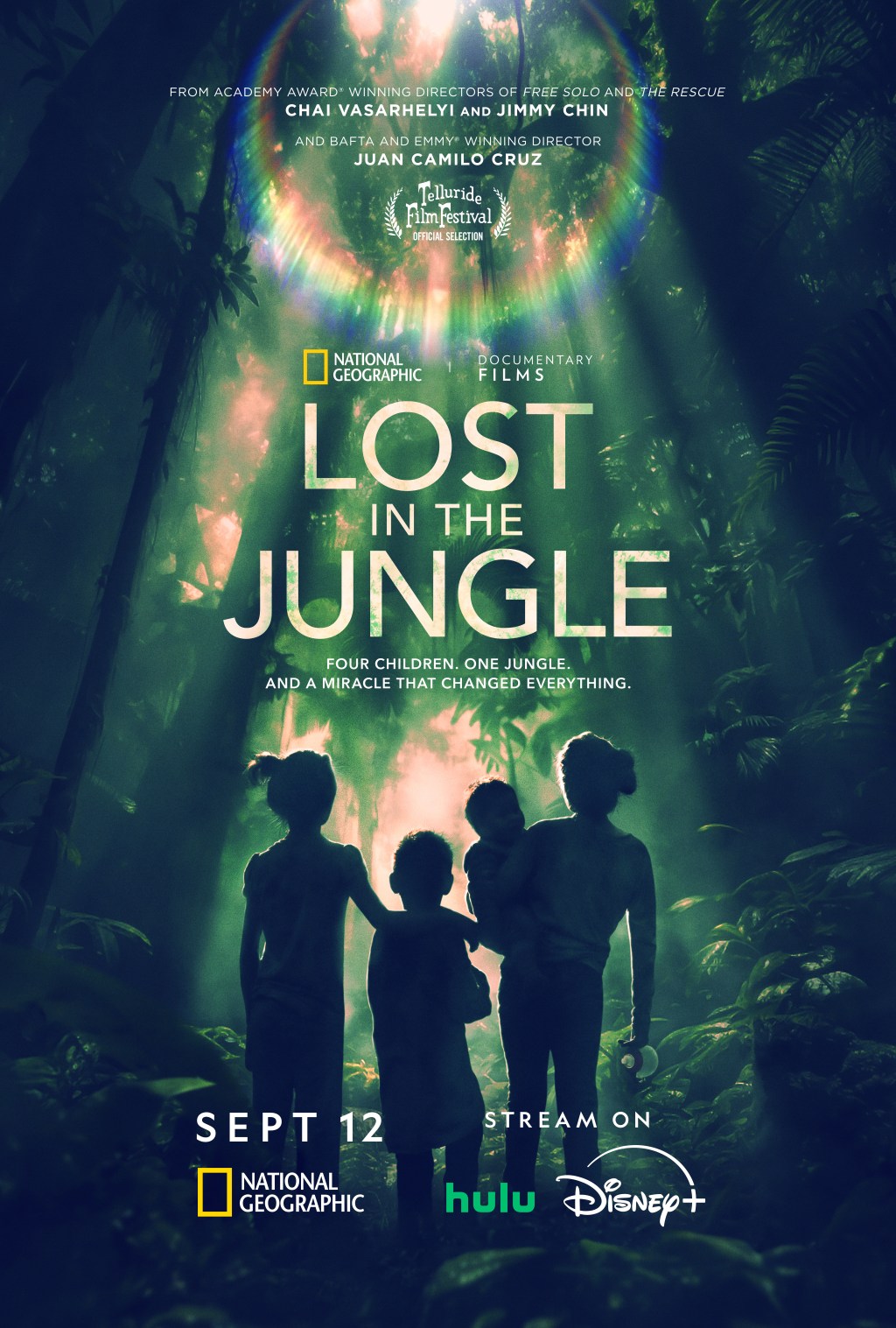
EXCLUSIVE: One of the greatest stories of survival ever told will premiere at the Telluride Film Festival this weekend.
Lost in the Jungle, directed by Oscar winners Chai Vasarhelyi and Jimmy Chin (Free Solo, The Rescue), and Juan Camilo Cruz (In Her Hands, Messi’s World Cup), will bow at the 52nd edition of Telluride before debuting on National Geographic on September 12, streaming on Disney+ the following day.
The documentary explores the incredible ordeal of four Indigenous siblings – ages 13, 9, 5, and the youngest just 11 months old – who went down in the crash of a Cessna aircraft in a dense and remote section of Colombia’s jungle in May 2023. The accident claimed the lives of their mother and the pilot, leaving the children to fend for themselves in an environment teeming with wild animals – predators included.
We have your first look at the film in the trailer above.

National Geographic
“I’m really excited for it to reach audiences. I think it’s a very inspiring and timely story,” Vasarhelyi tells Deadline. Referring to Lesly, the oldest sibling who took on the heroic task of trying to save her sisters and brother, she says, “There’s something extraordinary about her and her commitment and love for her siblings and kind of almost selflessness. It’s staggering.”
As the film recounts, when the plane was reported missing, Colombian authorities assumed there was no chance of survivors. A unit of military special forces set out to try to find the wreckage; separately, so did an Indigenous search team. It was a member of the Indigenous team who located the demolished aircraft with two bodies inside. Judging from a makeshift bed of leaves discovered nearby, it became clear the kids had survived the impact, but their whereabouts was a complete mystery.
“At that moment in Colombia, it became huge news,” Cruz confirms. “Everybody was following as if we were following the World Cup, basically everybody cheering for [the kids] to show up. It created a huge movement in the country.”
The desperate search became an international story, and friends of Vasarhelyi and Chin alerted them to what was unfolding, knowing how they had made the gripping 2021 documentary The Rescue, about the dramatic effort to save 12 boys and their coach trapped in a flooded cave in Thailand.
“When I understood that these children had been lost for 40 days in the jungle, and that it was a 13-year-old Indigenous girl and her younger siblings, including an infant, I was like, there’s something extraordinary here,” Vasarhelyi recalls. “Indigenous girls or Indigenous children in general don’t really get the opportunity to share their own stories. And that was something that felt urgent to me. I wanted to get the full 360 access so that I could tell the story thoroughly, which I wasn’t able to do on The Rescue [where story rights were divided between National Geographic and Netflix]. So that was kind of the objective here. We partnered with Juan, we also partnered with Lightbox and Simon and Jonathan Chinn, because they had secured certain access with the military, and so I was able to bring everyone together.”
She adds, “I have to say it’s been a real joy working with Juan Camilo on this film. It’s very unique and it’s very complicated and somehow it was necessary to have all these different kind of players together.”
A recreation scene of mom Magdalena and the four children approaching the plane with their bags.
National Geographic/Anita Gallón M.
Lost in the Jungle combines footage shot in the jungle as well as some recreations – for instance, of the children boarding the plane (for a flight meant to take them to Bogotá where the oldest children’s stepfather had fled after facing allegations of physically abusing the kids’ mother), and of the aircraft plunging into the canopy of trees. Distinctive animation helps evoke the mystery of the jungle, which Indigenous believe is home to spirits – some of them malevolent.
An animation of the children in the jundgle: Tien, Lesly, Cristin and Soleiny.
National Geographic
“We had the real people go to the real places and show us what they did. I think it was different with the children. We didn’t do that. They do tell us their account, but in terms of how to include their voices during the film, we made a choice of using animation because that seemed like the most appropriate way to go,” Vasarhelyi explains. “It’s a blended animation, which is bringing the real images of the jungle but using a very light animation kind of line drawing to conjure the children’s point of view and how they were faring.”
Lesly isn’t seen on camera until the end of the film, but in narration she shares all she was going through.
As a release about the film notes, “For the first time ever, the four Indigenous children who survived the Colombian plane crash on May 1, 2023—and then endured 40 days alone in the jungle—share their extraordinary story of survival, told in their own words.”
The Indigenous search team and Colombian military stand together in the jungle with the national flag.
Courtesy of Indigenous Rescue Team
The documentary explores the distrust that existed between the military special forces and the Indigenous rescuers. The soldiers feared the possibility of some Indigenous having ties to guerrilla groups who lurk in the jungle; the Indigenous could sense that suspicion and also felt the military didn’t respect their ancient and intimate knowledge of the jungle. Ultimately, the groups managed to overcome their differences for the sake of the missing children and to work together. That involved the special forces paying due heed to Indigenous cosmology which suggested a malign shapeshifting being known as a duende was conspiring to hide the children from their would-be rescuers.
“You’ve got these Colombian special forces who are the elite of the elite and for the most part Catholic, and they genuinely begin to believe and respect the Indigenous Huitoto belief systems, and they’re using Blackhawks [helicopters] to transfer alcohol to appease the duende. I mean, it’s wild,” Vasarhelyi exclaims. “There are lots of differences here, but they’re able to somehow find this moment of common humanity to be able to effect this rescue.”
The filmmakers, too, showed respect to the Indigenous.
“Once we arrived in the jungle, the first thing we did was to ask permission to film. We went to the communities and the grandfathers and the [Indigenous] elders there to give us the blessing,” Cruz recounts. “The [film] team, one by one, went to tell them what was their purpose to get into the jungle and why they were doing that. And they gave us their blessing.”
He adds, “We were with a German filmmaker who was the DP. And once we got to make our first shot, this blue butterfly just comes in and lands on the lens. It’s just something that you can’t describe, but you understand that it’s beyond your understanding and it’s super powerful.”
It was knowledge of the jungle that helped Lesly stay alive and save her siblings, Cruz believes.
“She was more comfortable in the jungle than she would’ve been in a city. She had never seen a building or a car, and it was the first time she was even on a plane, but she could understand which are the differences between the plants and the animals and everything that was living in that environment,” he observes. “There is a miracle behind it… It’s very unreal that four kids could have survived in that way, but they did.”
Watch the trailer for Lost in the Jungle above.
