

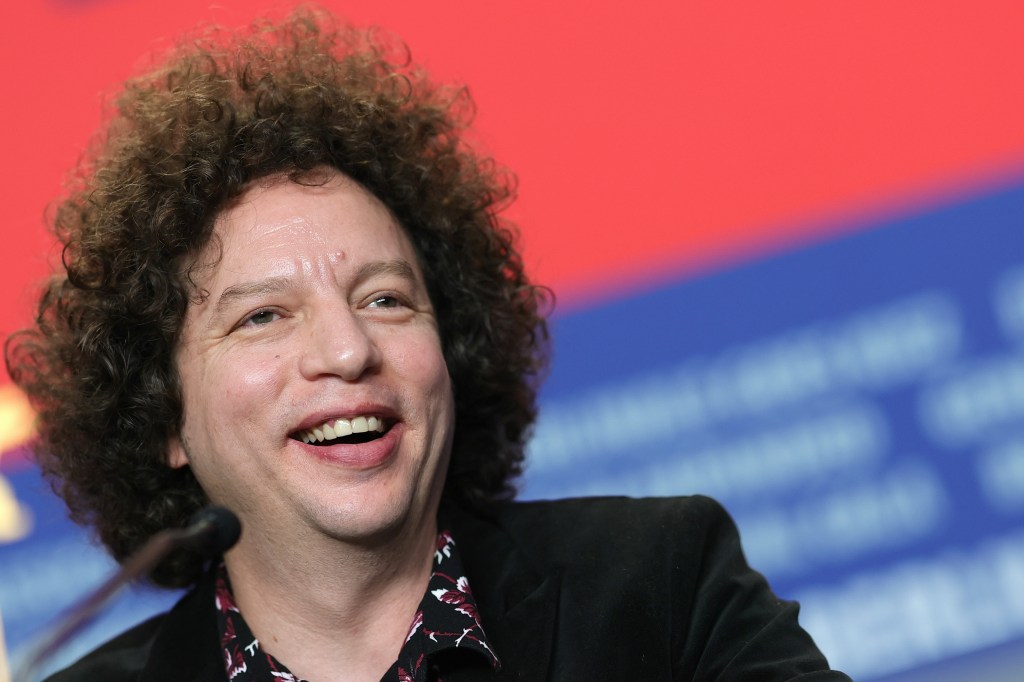
Michel Franco is no stranger to the Sarajevo Film Festival. Speaking at a masterclass at the Bosnian Cultural Center on Monday, the prolific Mexican filmmaker, who is presenting his latest feature Dreams at the festival, remarked that this year is his tenth time at the festival.
“When I was first invited to screen my film at the Sarajevo Film Festival, I told myself that I had to accept,” he said. “You only get a chance like that once in a lifetime – to come to Sarajevo. Who knows when another invitation would come? And here I am now, probably for the tenth time in Sarajevo, which has become my second home.”
The Memory and New Order writer-director-producer sat down for a wide-ranging discussion with Bosnian Australian journalist Ennis Ćehić to share his insights into filmmaking, his writing process and how he maintains creative control in much of his work by producing his own films.
“I write films on my own because I want to better understand some of the things that have questions on and I know I won’t get the answers to at the end, but I want to find out more about why I’m attracted to these things and these people,” he said. “So, through the process of writing and making the film, my understanding changes or deepens and it’s a privilege to make films about the things that trouble me and to explore them.”
He continued: “I am definitely never trying to feed the audience with an answer because I don’t have the answers. I’m not making films that make you feel that at the end you learn something. That is exactly the type of filmmaking that I despise – when a filmmaker is arrogant enough to want to educate the audience, which usually happens with some sort of satisfying, happy ending where you go home and learn a lesson. I think that’s mainly Hollywood’s game.”
Franco’s latest film Dreams, starring his frequent collaborator Jessica Chastain, is a twist on the star-crossed lovers romance which sees Chastain play a wealthy socialite who has a romance with a Mexican ballet dancer. The film is continuing its festival run after premiering in competition in Berlinale earlier this year.
Franco said it was an idea he had for a decade and when on the set of Memory, which also stars Chastain, he told her about the idea for Dreams, and she was keen to board the project.
When asked whether or not the “cruelty” in the film “matches the reality between the U.S. and Mexico,” Franco responded: “No – if we try to have that conversation, it falls short. I’m more into the intimate story and what these two people do to each other.”
He said that if he were to make a film about the two countries, “it would resemble New Order,” referring to his dystopian drama about inequality.
The multi-hyphenate said that being born in Mexico – where he still lives – and sharing such a large border with the U.S. means “we are born into a reality where one country is on top of the other and that’s the deal and it’s never going to change.”
He continued: “The power dynamics are very clear. So, I was always trying to make a film about that, but it was only through an intimate love story – if we can call it that – it occurred to me. I wasn’t thinking so much of commenting on the two countries.”
Franco said that he was driven by ideas that make him feel “uncomfortable.” “As soon as I start – if any ideas start to make me feel uncomfortable, I say that’s good and that’s exactly where I should go. Why am I feeling uncomfortable? I never try to make it easier for myself or the audience.”
He regaled how he stepped into the producer’s role, something that happened on his debut film After Lucia. His friend Marco Polo Constandse, who was set to produce the project, told him it couldn’t be produced for less than $800,000 and that they wouldn’t be able to shoot in chronological order (something Franco does on all of his films). “I sat down the same day, I worked on a budget myself and I called him back and I said, ‘We can shoot for nine weeks in chronological order for $150,000.’ And so, we did.”
He continued: “To lower the budget you don’t pay people less – you simply hire less people. So that’s when it started. There’s a lot of creative thinking from individuals.”
Franco said for that production he didn’t use a production design team and that he still doesn’t use them often and that he also often edits his own work.
“You focus on the people, and you focus on the actors. I trust my cinematographer and but it’s not that we design a film, but we adapt ourselves to what we find and that’s a more interesting process than just storyboarding something and saying this should be fluid.”
He continued: “The real trick is to surround yourself with talented people who understand what you want better than you do.”
