

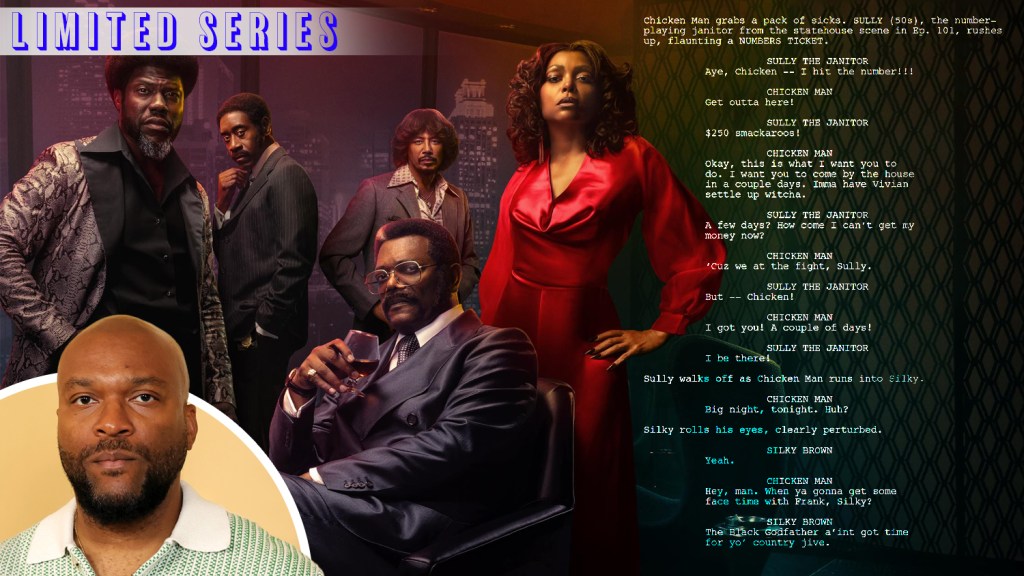
Editor’s note: Deadline’s It Starts on the Page (Limited) features 10 standout limited or anthology series scripts in 2025 Emmy contention.
When you have a limited series called Fight Night: The Million Dollar Heist, viewers want to see the main event, in this case, Muhammad Ali vs. Jerry Quarry in 1970, the backdrop for an armed robbery that changed the lives of many and Atlanta as a whole.
In Episode 101, the main players are introduced, with the cast of heavy hitters including Kevin Hart as Gordon “Chicken Man” Williams, Taraji P. Henson as Vivian “Sweets” Thomas, Don Cheadle as Detective J.D. Hudson, Samuel L. Jackson as Frank “Black Godfather” Moten, Terrence Howard as Richard “Cadillac Richie” Wheeler and Dexter Darden as Ali. Episode 102, titled “Round Two: Fight Night,” gives the audience a bird’s eye view of the fight — as well as the heist — from various perspectives, combining the cast’s star power with Ogbonna’s writing, Craig Brewer’s direction as well as elaborate costumes and set designs.
Fight Night: The Million Dollar Heist was created by Ogbonna, a native of Atlanta passionate about telling his city’s origin story with nuance and flair. As he shares in the introduction for his script below, through the experience, he discovered that he had a family connection to the heist, which he has previously revealed to be to Chicken Man.
Two things you’ll find out a few minutes into a conversation with me: I tell stories for a living, and I’m from a place called Atlanta. For me, Fight Night isn’t just a crime story. It was the opportunity to tell the origin story of my city.
What drew me into the project wasn’t just the spectacle of the heist, but the idea that this one night in 1970 marked a transition — from the shadows of Jim Crow to the “City Too Busy To Hate”. Fight Night became a way to explore the soul of that shift — through hustlers and preachers, cops and kingpins, veterans and dreamers. People trying to stake their claim in a country that rarely made room for them.
Episode 102 is when we shift perspective and see the heist from every angle— not just as an act of desperation, but as the culmination of years of trauma, and survival instinct. These weren’t just stock criminals; they were men and women shaped by their environment, by the need to matter in a world that often rendered them invisible. That choice to humanize the figures behind the masks took on an eerie weight when I later discovered I had a personal connection to one of the real-life robbers.
Suddenly, it wasn’t just history. It was personal.
Writing 102 took time. I went through countless drafts, trying to balance the tone, layer in the flashbacks, and make sure each member of the crew felt distinct and real. I finally cracked the structure once I saw the episode as a companion piece to the pilot. If Episode 101 introduced “what happened”, then 102 began to explore the “why” of it all. And that approach is clear from the opening scene — a flashback of Chicken and JD that gives the audience insight into their disdain for one another.
If there’s a line I’m especially proud of, it’s JD Hudson’s post-fight monologue about his high school football team being robbed of victory by a rigged system: “They even turned off the damn scoreboard.” It’s a quiet gut punch. JD’s lament isn’t just about a game. It’s about the bitter truth of growing up knowing that even when you win, someone might still find a way to take it from you. That line, like the episode itself, is a snapshot of an America that doesn’t feel as far off as we’d like to think.
Watching 102 come to life under Craig Brewer’s direction, and brought home by iconic artists like Don Cheadle, Taraji P. Henson, Kevin Hart, Terrence Howard, and Samuel L. Jackson, was a surreal and emotional experience. To see these characters breathe, to watch Atlanta rendered with grit and beauty, was one of the proudest moments of my career.
This episode was the most fun I had writing on this show. I hope you enjoy it.
Shaye Ogbonna
Read the script below.
