

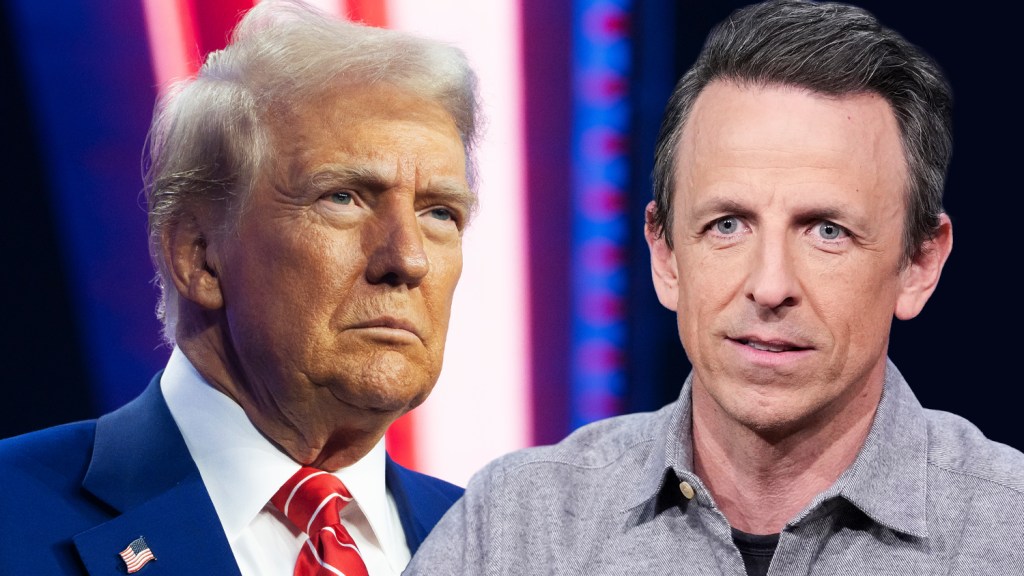
Even as traditional TV networks grapple with balkanized audiences and relevance at a time of YouTube and so many options, Donald Trump still has his attention on his most persistent broadcast critics.
Late on Tuesday, the president wrote on Truth Social, “There is a sick rumor going around that Fake News NBC extended the contract of one of the least talented Late Night television hosts out there, Seth Meyers. He has no Ratings, Talent, or Intelligence, and the Personality of an insecure child. So, why would Fake News NBC extend this dope’s contract. I don’t know, but I’ll definitely be finding out!!!”
Meyers, who has hosted NBC’s Late Night for more than a decade, signed a new contract last year that extends his deal through 2028.
A spokesperson for Late Night with Seth Meyers said that they had no comment.
This is not the first time that Trump has called out Meyers. In January, just before taking office again, Trump threatened that Comcast, the parent company of NBC, should “pay a BIG price” for featuring the show, calling it an “in-kind” contribution to “the Radical Left Democrat Party.” Trump appeared to be conflating the FCC‘s equal time rule with the fairness doctrine.
The equal time rule requires broadcasters who feature candidates to provide airtime to rivals if requested. But there is a “bona fide” news exemption, one that the FCC has extended to late night talk and other infotainment shows. Meyers’ show would fall into the category if he had featured a candidate.
If it was just Meyers expressing a political point of view, which he does night after night, the network would not be obligated to present other sides. That’s because the FCC did away with the Fairness Doctrine in the 1980s. That mandated that broadcasters provide a diversity of viewpoints.
That said, Trump’s FCC chairman, Brendan Carr, has seemingly adopted a de facto Fairness Doctrine when reviewing proposed mergers before the agency. He trumpeted Skydance’s commitment to provide a diversity of viewpoints at CBS following the FCC’s approval of the company’s merger with Paramount Global. But there are doubts that such commitments, even it comes down to it, are even enforceable.
Just days before the FCC approval, CBS announced that it was cancelling The Late Show with Stephen Colbert, hosted by another Trump critic. The network cited financial reasons as the economics of late night have shifted. Meanwhile, another Paramount show, South Park, has been scathing in its satire of Trump. But that show runs on Comedy Central, a cable channel largely outside the bounds of FCC enforcement.
