

SPOILER ALERT: This interview contains details of Season 1 of Government Cheese
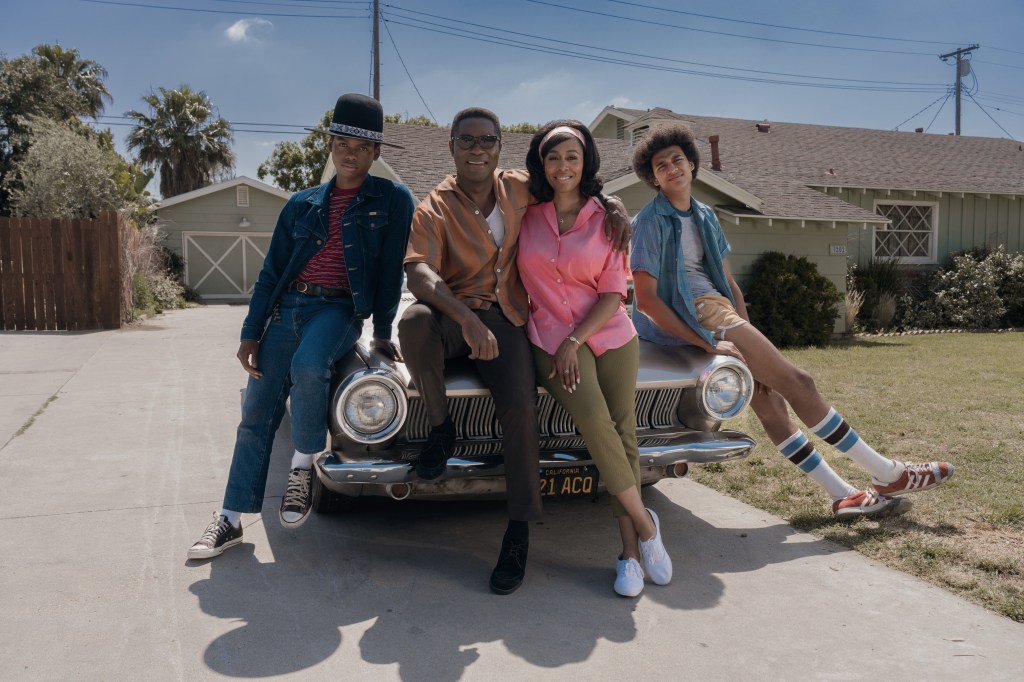
In Apple TV+‘s latest caper, Government Cheese, family is at the forefront. Co-created by Paul Hunter—who also serves as co-showrunner, executive producer, writer and director—the surrealist dramedy set in 1960s San Fernando Valley tells the story of the Chambers family, an eclectic bunch of individuals with their own awe-inspiring passions and desires. The striving family is soon plagued with drama and hijinks upon the return of Hampton (David Oyelowo), the husband of Astoria (Simone Missick) and father of their two children, Harrison (Jahi Di’Allo Watson) and Einstein (Evan Ellison), after he is released from prison.
Here, Deadline speaks with Hunter about inspirations, family ties and portraying the nuclear Black family.
DEADLINE: I read that your family inspired this series.
PAUL HUNTER: Yes. It’s about real expression. It’s about how I was feeling and how we were fitting in at the time and my dad coming out of incarceration and wanting to connect with him. So, I just wanted to have that personal feeling out there.
DEADLINE: Were you more Einstein or Harrison?
HUNTER: I’m more Harrison because I just struggled with finding my purpose or connection with a group and where I fit in. Harrison has this thing with the Chumash. I was really into Native American culture when I was younger.
DEADLINE: Are you LA-born and raised?
HUNTER: Yeah, LA and the Bay Area, but mostly in San Fernando Valley.
DEADLINE: In thinking about some of the themes of belonging and career shifts, was there any other path for you other than filmmaker?
HUNTER: It’s interesting because I played a lot of sports, but I wasn’t really going anywhere with that. I was always interested in photography classes. I would just get lost. I remember, as early as junior high, having a first-period class and not leaving that and missing all my classes just living in the dark room. Part of where the aerospace thing comes from with Hampton’s story is that I used to work around a lot of machine shops out in the South Bay. I found that I was one of the few Black men in that industry.

Government Cheese
Apple TV+
DEADLINE: Let’s talk about casting your leads, David Oyelowo and Simone Missick.
HUNTER: It started out as a short film. Originally, I was kicking it around, aiming to do a feature. So, when no one was really getting the idea, I said, “Let me make a short film.” Then I started going around talking to different people, and a production designer friend of mine said, “Hey, you know what? You should reach out to David. I think he would really like this material.” He had worked on Nightingale with David. So, I called him, we sat down, and I gave him a script. He agreed to do it, and we shot it at my mom’s house. With Simone, I met her through [someone], and she was fantastic. She’s got a very warm feeling, which reminded me of my mom. Astoria, the character she plays, is based around my mom. She was just a very creative person. Also, when I think about my parents, I remember that my mom was just playing music in the house. She was playing a lot of Steely Dan and Elton John, and my dad was playing a lot of Ohio Players. So, we had this really cool, eclectic world going on.
DEADLINE: Who was the most challenging character to write for?
HUNTER: All of this was so interesting because I wanted to tell so much about the characters, and there was only so much room because it was Hampton’s story. But the thrust is also Hampton and Harrison’s battle. I think I found it hard with Einstein because I wanted the audience to understand that he wasn’t just a flighty character who was disappearing or just a flighty character who just had all these wild thoughts, but he actually had a purpose in Hampton’s journey. He understood what his dad was going through the whole time and was just kicking back and waiting for it to come around to help him.
While creating this, I really wanted to push this idea and this show out there to connect with unique Black people. I just felt like this was a quirky, left-of-center show. So, it took me a long time to get there.
DEADLINE: It’s interesting you say that. There is a sense that it’s a Black show, but it doesn’t really address the common themes of Black trauma. But there is the occasional acknowledgment of race. Was this a conscious decision?
HUNTER: A hundred percent. I just felt like those areas have been covered pretty well, and the way I grew up, my family and my mom was always encouraging us to go for our dreams and not really worry too much about what was going on around us. She kept us in this creative bubble. I wanted to focus on them pursuing their dreams in a really unique way.
Government Cheese
Apple TV+
DEADLINE: What were some other inspirations?
HUNTER: There’s an Addams Family clip in there. In the pilot, the family’s watching TV at the very end, and there’s a character in the clip that says to them, “Addams, you guys are kooks,” so for me, [this show] is like a weird Addams Family type of thing. Because all these crazy things are happening around them, but they’re in their own world. Also, a lot of the photography of William Eggleston and Stephen Shore, they shot pictures of suburbia, but they did it in a really quirky way. I’ve always loved how Paul Thomas Anderson shoots in the Valley, and so I thought, oh man, I want to shoot in the Valley and tell my story. Then there’s the Cohen brothers and how they approach their oddness. David Lynch would be another when I think about the mountains or Chatsworth, and you see the rock flats. That’s where the Chumash territory is. And then there’s a lot of aerospace companies in the Valley where they do engine testing. Growing up in that area made me want to tell this story. I felt that if we approached it in tableaus, much like how some of the Cohens create stories, there are really great tableaus that help sell the tone and quirk. And that’s really what I wanted to make sure that we nailed. Because there’s not a whole lot going on, but if you fit in it, there is a lot going on.
DEADLINE: There’s also a lot of magical realism going on in the show. I’m thinking about the scene with Hampton and the fish or the woman who shows up to help him talk to his wife, but then she disappears at the end of the episode. Then there’s also religious references.
HUNTER: I grew up in the Pentecostal church, and I always wanted to talk about a spiritual journey. So, what this means is I thought it would be interesting to see things visually. My brother and I always talked about our dreams and how they felt so real sometimes. For Hampton’s character, I thought of him as Jonah in the belly of the whale, and then he comes out, and he’s got this job to do that he’s challenged with: do I go to Nineveh and deliver a message, or do I go the easy way? And that’s the whole point of the story: when Hampton comes out of prison, he immediately faces these challenges. Does he give up on his dream? Does he tell his family what’s going on? Or does he try to figure it out himself? And it’s always these forks in the road. That’s where all that comes from. Is it really happening? It could? But maybe not. It’s just in his thoughts, but God is speaking to him. Like the guy who is the fisherman, after Hampton’s robbed the temple, he has the money, and the fisherman says, “Go to Nineveh.”
Nineveh was a place that Jonah feared. And once God gets his attention, he says he’ll go and do what God wants him to do. So that moment of being stuck in the fish is when Hampton decides, OK, I’ve got to give this money back to the temple. I have to start all over and face all of this, pushing through these fears. This is what I’m essentially saying with all the characters. Astoria has a fear of going for that job interview. Harrison doesn’t feel like he fits in with his family. He feels like he’s a part of the Chumash. But he’s really trying to wrestle and needs to unravel things with him and his dad. So, he’s not facing his fears. Einstein has all the answers, but he’s too afraid to move forward.
Government Cheese
Apple TV+
DEADLINE: So, in the end, Astoria does decide to still help him evade going back to jail. Talk about that decision.
HUNTER: One of the things that I remember thinking about during this time period is what does it take for a Black family to survive? What does it take for a family to survive? And I think, in this case, this is her moment to go pursue her dreams. The other part, now Hampton needs to deal with the boys the way she had been dealing with the boys for years. He was supposed to come out and do the right thing. His actions are a ripple effect for the family to try and push out. Even though he’s alone at the end, he inspires, in a bizarre way, for Astoria to go for her dreams, and I think she understands that.
In a sense, that’s where my story comes in with my dad. As a teenager, I could have easily fell into trouble. But I wanted to connect with my dad and wanted to have that relationship with him, which is similar to the way Harrison was. Harrison is an edgy kid. And so, my dad was like, “Hey dude, why would you want to go that direction? Look at me. And you could go much further than I did.”
So, to look at a guy coming out of incarceration saying, oh, he’s a wash, but he had something. He inspired us to go further. That was his job. Perhaps if he hadn’t been in there, maybe he would’ve told us something different. But it all depends on how you look at it.
Government Cheese
Apple TV+
DEADLINE: Is Hampton redeemable overall? How would you like audiences to view him?
HUNTER: Well, I think that he’s definitely on a journey that is not straightforward, and I think that there will be some redemption there, but I really wanted to make it as hard as possible for that character, just to show the point that the real thing is about perseverance, and it’s not easy to go after your dreams. Everything isn’t going to lay out just as you want. So, it’s about perseverance. And so, in his redemption path, it’s not going to be that easy, but I think that gives us something to work towards [for a potential Season 2].
[This interview has been edited for length and clarity.]
