

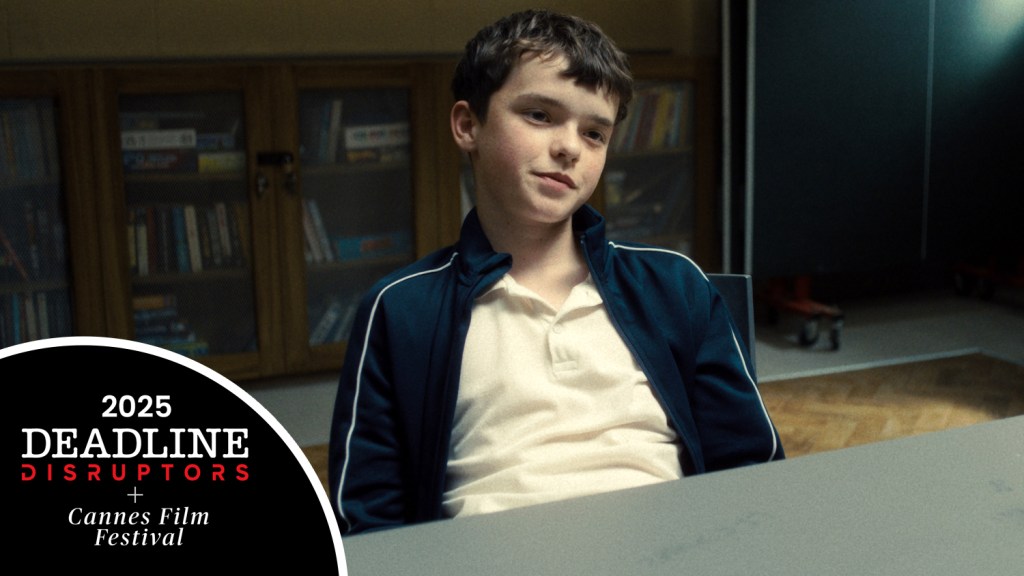
Since Adolescence premiered in March, Netflix’s breakout TV hit of the year has reverberated through homes, schools and political discussions around the world.
At the time of this interview, co-creator Jack Thorne has just visited 10 Downing Street — the home of U.K. Prime Minister Keir Starmer — to discuss both the limited series’ outsized impact on the public consciousness, and what can be done to help solve the societal ills it examined.
Starmer has recently taken the rare step of pronouncing his love for a Netflix show and simultaneously making it part of the nationwide school curriculum, deeming it vital viewing for all young people. However, others, such as Elon Musk, and Starmer’s opposite number, Conservative Party leader Kemi Badenoch, have spread an unfounded conspiracy theory about its main character. Predictably, the media has been in overdrive.
Away from Adolescence being used as a political football, the show, produced by Brad Pitt’s Plan B, Warp Films and Matriarch Productions, has in the past few weeks been redefining the notion of a breakout hit. At the time of writing, this local British series about a murder committed by an extremely troubled teen and the ensuing fallout, starring its co-creator Stephen Graham, Erin Doherty, Ashley Walters and rising star phenomenon Owen Cooper, had become the third most-watched English-language Netflix series of all time. When one considers how quickly this milestone was crossed and ponders the show’s subject matter, this achievement almost defies belief.

(L-R) British Prime Minister Keir Starmer meets with ‘Adolescence’ writer Jack Thorne
Jack Taylor/Getty Images
“I’m still massively surprised,” says director Philip Barantini, the pioneer behind Adolescence’s disruptive one-shot style and a man whose stock has risen enormously. “You make a little series in a specific northern town in the UK and hope people get it, and suddenly you are getting messages from India, Venezuela and the U.S. But the themes are common across the globe, and I think that’s why it has resonated.”
Those themes are where it all began. Adolescence started with Graham’s shock at the stabbing of a young girl by a teenager in his home city of Liverpool. This set the Peaky Blinders star thinking about why modern society was driving teenagers to behave in this way, the terrifying role of social media and what could be done. Fast-forward several years, and it could be argued his show has done more than any politician in recent memory to begin addressing the problem.
Graham recalls spending his teenage years in youth centers playing soccer with friends and compares this to a reckoning he and Hannah Walters, his wife and fellow Matriarch Productions founder, experienced during the pandemic with their kids.
“There was a disjoint at a point in my life between me and Hannah and both of our teenagers,” he adds. “We had to work very hard to mend that and understand why they were spending so much time in their rooms. We put a lot of effort in and started to ask questions and find things out.”
Having journeyed through a lengthy development pathway with Amazon, before being snubbed by now-ex Amazon MGM content boss Jennifer Salke, Netflix speedily snapped up the show and the jigsaw fell into place.
Graham had worked with Barantini on the BAFTA-nominated Boiling Point, which took a similar one-shot approach, albeit in a smaller precinct, while Graham and Thorne had collaborated plenty down the years, including on gut-punching shows like The Virtues.
So much of the discussion around Adolescence has correctly highlighted the one-shot direction, but creators Thorne and Graham took a fresh approach to the writing too.
“Stephen knew I was a serious bugger who was into the darker issues of the world,” Thorne says. “He called me and asked me to write it, and it was me who said, ‘Why don’t we try and write it together?’ It was my keyboard, and Stephen would just talk to me, and I told him that it would be his responsibility to challenge me and unpack his brain with me.” Thorne and Graham’s speak-and-type writing process could be replicated on future projects, Thorne thinks, although he stresses there needs to be an “intimacy” between the pair, and they need to “care about each other” in order for it to work properly.
He points to Adolescence’s third episode, arguably the most painful, in which Cooper’s Jamie Miller spends an hour with child psychologist Briony Ariston (Doherty) who is trying to better understand his motivations. Virtually the entire episode is spent in one room with just Cooper and Doherty.
“I don’t know if I’d have had the guts to do this if it wasn’t for Stephen saying, ‘OK, write a David Mamet play,’” Thorne says. “I would have found ways to get out of that room, but Stephen said, ‘It needs to be one conversation,’ and his belief kicked me up the ass.”
With help from execs, Thorne and Graham combined to make the Adolescence scripts feel as real, nuanced and simultaneously dramatic as possible. And it’s here that the director stepped in. Barantini was always clear that each episode would need to be filmed in one continuous take to up the ante and urgency. That process has been covered in the press plentifully over past weeks, but it bears repeating. Featuring around 320 extras, each episode was filmed in a four-week block that mostly comprised technical practices and rehearsals. The final week would feature two takes per day, leaving the team with at least 10 to choose from at the end of the week. During takes, Barantini would mostly watch on from a vehicle disguised as a police van for the purposes of the show.
Stephen Graham as Eddie Miller in ‘Adolescence’
Netflix
Scenes where actors were moving between locations were particularly tough. When Adolescence first started gaining word-of-mouth traction, audiences marvelled at a drone shot moving from the school to a memorial site for Jamie’s victim Katie. People couldn’t understand how a camera had seemingly broken through a window, and they were flabbergasted by the way in which Graham’s character seemed able to calmly drive a van while performing one of Adolescence’s most emotive scenes.
Barantini has unsurprisingly landed himself the status of a one-shot pioneer, but he stresses that there have been many before him. He pays tribute to Hitchcock classics like Rope and 2015 single-take German crime thriller Victoria, while pointing to innovative techniques such as those deployed by Jonathan Glazer’s CCTV-like The Zone of Interest.
“Victoria just blew my mind,” he says. “It was the feeling I got from it and what it did to me. I’d never experienced that before. It’s about being bold and saying, ‘Do we really need to see this person’s face, or can it just be played out in a wide angle while we’re staring at an apple on the table?’”
Barantini has been on quite the journey, having started out working in restaurants and bars before acting in shows like Band of Brothers, The Responder and Chernobyl. It was the passing of his mother nearly a decade ago that pushed him to go after directing, he says. “That was the moment where I said to myself, ‘I don’t give a sh*t. I’m literally going to give it everything, and I’m not going to stop until I know that I’ve worked so hard to get where I want to be.’”
Barantini is currently directing Enola Holmes 3. He stresses that he “doesn’t want to be known as the one-take guy,” noting that there are “massive limitations” when it comes to one-shot. “Unless you’re going to stitch it together and fake it, you can’t play with time,” he adds. “You’ve got a window, a moment in time, a slice of life and a slice of this specific moment. It’s very limiting and doesn’t lend itself to everything.”
But it certainly lends itself to the subject matter that Barantini, Graham and Thorne are passionate about tackling. Along with Boiling Point, Barantini has made a short, Seconds Out, about a young man learning to cope with his mental health issues, and Netflix feature Accused, which, like Adolescence, deals with a world of social media pile-ons. “I always say that everybody has at least two masks they wear,” he says. “One is the mask which puts on a front, and the other is that mask at home.”
These themes will out in Adolescence, but in something of a case of life imitating art, social media conspiracies have gripped the show’s discourse, with the likes of Musk and Badenoch engaging with a disproven theory that Jamie Miller is based on the Southport killer Axel Rudakubana, but had his race changed in the show from Black to white. Graham and others involved with the show have since been accused of being “woke” and “anti-white”, yet Rudakubana’s crimes happened long after the idea for Adolescence had been put down on paper.
“That was a really strange experience,” says Graham. “I find it interesting to hear some of the theories people are coming up with when this was something that came from my own head. But that’s the thing about art, it can always be subjective and can always be twisted to make a certain agenda.”
Read the digital edition of Deadline’s Disruptors/Cannes magazine here.
Given that the show explores the crushing impact of social media, Graham highlights the irony of the criticism coming from keyboard warriors, while at the same time, he says, “You’ve got people coming up to you in [British supermarket] Tesco saying, ‘Oh my god it’s magnificent, thank you so much.’ No one has approached me and called me anti-white to my face or said I’m pushing a negative agenda.” Partly for this reason, and despite Plan B saying that they are chatting to Barantini about Adolescence’s “next iteration,” Graham rejects the notion of an imminent second season. “Nothing is ever going to have the impact that this has had,” he says.
Thorne remembers that day at the prime minister’s home and ponders how the most crucial element of the meeting was that it was not just him and the other creators speaking with Starmer and his entourage, but also stakeholders who had been campaigning on these issues way before Adolescence was in the ether. “It’s extraordinary that we have attracted [Starmer’s] attention, but the good thing about Downing Street was that it wasn’t just us around that table,” says Thorne. “This is the beginning of a conversation. It’s clear people are desperate to talk and are hungry for a prime minister that listens. And I hope that he keeps listening.”
