

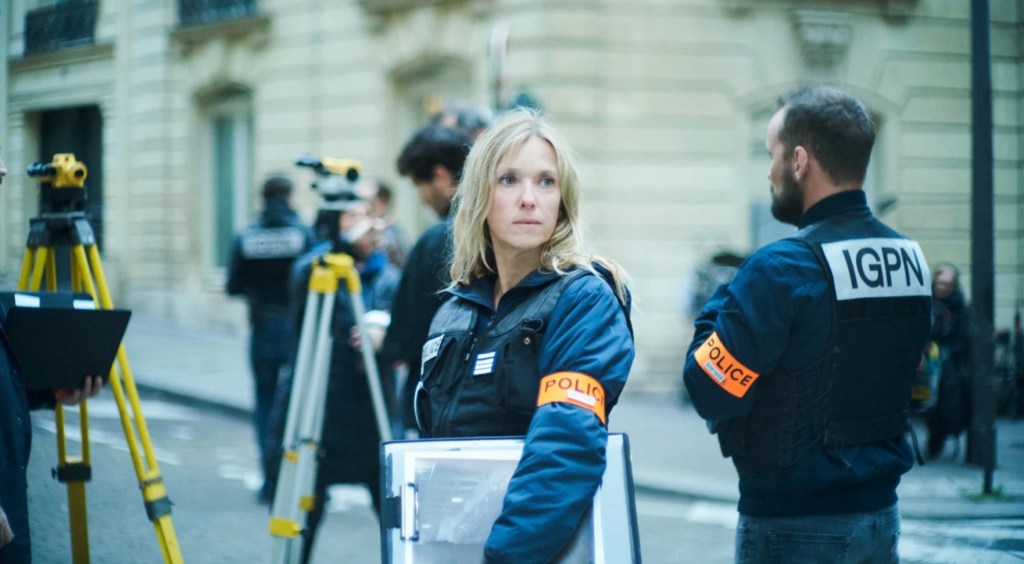
Sometimes, the stacks of paper on Inspector Bertrand’s desk pile up so perilously that it look as if she is about to disappear under an avalanche of files; her computer screen is like a retaining wall, with the thin, ferrety inspector burrowed in behind it. Stéphanie Bertrand’s (Léa Drucker) job, which she performs with dogged rigor, is to investigate complaints against police officers. In Dominik Moll’s Dossier 137, we join her in the wake of the 2018 gilets jaunes demonstrations, when 300,000 rural workers, mostly newbies to the rough and tumble of street politics, surged into Paris. Many went home wounded. Bertrand’s files are piling up.
French-German director Moll has made his considerable name with psychological stealth thrillers, peopled with eccentrics and spiced with peculiar motifs like the persistent rodent in Lemming (2005), the raw eggs quaffed by Sergi Lopez in Harry, He’s Here to Help (2000) or the body in the haystacks in Only the Animals (2019). His particular twist on genre is a morbid, gleefully amoral humor; there is nothing like a revenge killing, under certain circumstances of Moll’s choosing, to clear the French provincial air.
RELATED: Full List Of Cannes Palme d’Or Winners Through The Years: Photo Gallery
Dossier 137, by contrast, is a police procedural of serious purpose and sober delivery. A fiction based on fact, as a preliminary title tells us, it shows the wheels of justice grind into slow motion after Joelle Girard (Sandra Colombo), a middle-aged care worker, arrives with gruesome pictures of her teenage son Guillaume (Come Peronnet), now suffering brain damage after being shot in the head by a posse of riot police when he and his friend Rémi (Valentin Campagne) were running up a side street, trying to escape the mayhem. They had come as a family to protest their town Saint-Dizier’s declining bus services; they thought it also would be a chance to see Paris as a family. Their betrayed ordinariness weighs on the heart.
This is still quite recognizably a Dominik Moll film. He and his co-writer Gilles Marchand bring into play their experience with suspense and an insistent narrative rhythm so that, while it isn’t exactly fun, it is gripping. The calculated release of information keeps the audience in lockstep with the investigators, keen to see what they will turn up next. The inspector tracks down the police with CCTV footage, calls them in, asks questions. Speaking directly to camera, they lie. Also speaking to camera, the various members of the Girard family waver between resentment and bewildered confusion.
Months go by. Rémi was arrested that day and given a three-month sentence. Nobody listened to him in court. But then, he says, nobody ever listens to people like him; that’s at the heart of his people’s grievance. He has consequently lost his job, a potential death blow in a dying town where work is already scarce. Inspector Bertrand understands this. She grew up in the same town. She also makes the mistake of keeping that to herself, a sin of omission that will be used against her when she comes uncomfortably close to making arrests.
RELATED: Cannes Bans ‘Dossier 137’ Actor Accused Of Sexual Assault From Red Carpet
As Stéphanie Bertrand, the tremendous Léa Drucker gives vitality to every move and counter-move in this measured account of police business. Drucker is able to conjure a frosty authority that is entirely convincing, while simultaneously hinting at vulnerabilities that nobody within the narrative is allowed to see. She is momentarily winded, for example, when her son Victor (Solàn Machado-Graner) asks her why everyone hates the police.
That’s not true, she says: they were fêted during the Bataclan attack. Hasn’t she noticed, he goes on, that all her friends are police? Nobody else wants anything to do with them. But most police don’t want anything to do with Bertrand, either. As an internal investigator, she’s breaking ranks. The police union defends any accused officer with a vengeance; she is seen to be smearing them. There are frequent pinprick suggestions of what that pariah status means; we see Drucker’s face flicker with pain, then reset into her habitual determination.
This is purposeful filmmaking, firm in its convictions. Bertrand’s decency is given substance by her cozy home, golden with the glow of lamps while everything else is an institutional gray. The sky, too, is always gray when she goes back to Saint-Dizier to see her elderly parents. Her father is genial enough; her mother mostly watches cat videos on the internet. She doesn’t want to hear about anything unpleasant, barely registering what her daughter does for a living. But the world is full of unpleasant things. Dossier 137, in its slow march toward a deflating finish, is overwhelming evidence of that.
Title: Dossier 137
Festival: Cannes (Competition)
Sales agent: Charades
Director: Dominik Moll
Screenwriters: Dominik Moll and Gilles Marchand
Cast: Léa Drucker, Jonathan Turnbull, Sandra Colombo, Come Peronnet, Solàn Machado-Graner, Valentin Campagne
Running time: 1 hr 55 min
