

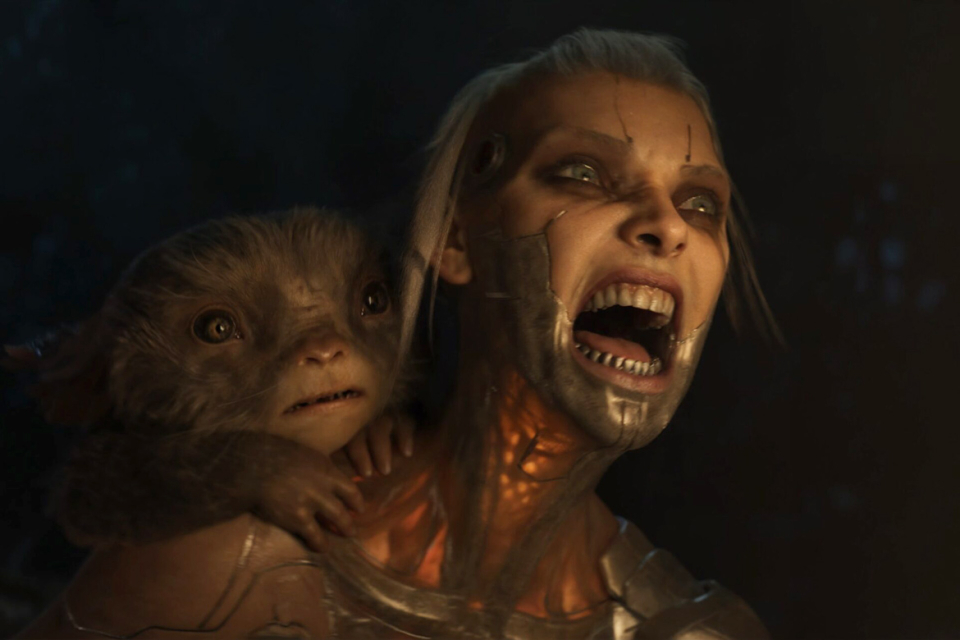
The short-form dystopian sci-fi series Love Death + Robots is back and more morally taxing than ever. One of the standouts of Season 4 is “Spider Rose,” an adaptation based on the 1996 Bruce Sterling short story of the same name from Schismatrix Plus, which follows a widow mechanist—a person enchanted by technology—who calls herself Spider Rose. Living alone in decades of isolation, Spider Rose is on the never-ending quest to destroy the Shapers —featured in Season 3’s episode “Swarm”—who killed her husband. Along the way, she befriends a small animal-like alien companion named Nose for Profits, who teaches her how to love again. However, when Spider Rose faces a brutal attack from the Shapers, things take a dark and twisted turn with the creature she trusts most.
Here, director Jennifer Yuh Nelson speaks to Deadline about the surprise twists and inspirations for the series.
DEADLINE: What keeps you fresh creatively as you bounce from lighter projects like Kung Fu Panda to more dystopian projects like Love Death + Robots?
JENNIFER YUH NELSON: I have a lot of hobbies. But right now, I have a very robust R&D project. I work on stuff at home all the time. I work on designing and writing stuff. I do things for myself that I’ll never show anyone, purely for the purpose of experimenting without risk and without anyone else’s opinions, marketing, or trends. I also consume a lot of YouTube. I tend to watch that a lot because it allows my brain to relax, and then I can float around to whatever is interesting. I can see colors and lights or get random information like people crawling into caves and getting stuck there or people trimming hooves and all sorts of weird stuff. I also watch a lot of international programs because a lot of the times, like Korean TV or films, they’re more experimental because they haven’t had as many decades of the system that we have here, so there tends to be a bit more strange, weird, quirky story twists and crazy ideas that I think people are really getting wise to now, obviously, because people are very excited about watching a lot of Korean media.

Love Death + Robots
Netflix
DEADLINE: So, Love Death +Robots has four seasons over the course of about six or so years. How long does it take to develop a season?
NELSON: It takes a long time to make these shows. I know people say, “Well, it took them long enough.” Well, usually, right after the show comes out, there isn’t that much of a gap between starting another season. Each season takes a couple of years. Just the fact that animation takes a long time. Premium animation takes a really long time. Experimental premium animation takes a very, very long time. So that quality takes time to cook.
DEADLINE: How do you all generate content to fill the gaps between seasons? I read something about creator Tim Miller using index cards or something.
NELSON: Well, there’s a huge tome, like a giant file of all these short stories, that Tim has flagged over the decades, and he’s put it into a long list. And so, we read them. And it’s a very organic process because you have to mix and match the tent poles and things that are different from those tent poles and make sure that there’s variety. So, you can’t all have one of the same thing. So, maybe there’ll be a story that Tim really loves, or I really love, or somebody else on the crew really loves, and they say, “It speaks to us,” and that goes on the wall. And then we move those around and put them next to other stories and see how they sort of play together. Maybe there’ll be a story about some crazy space battle, and then maybe there’s one that’s another crazy great story, but it’s also a space battle, and you can’t have two of them right next to each other. So that’s why we move things around. Things might end up floating from one season to the next season because we have to make sure they play well together.
DEADLINE: “Spider Rose” takes place in the “Swarm” universe from Season 3. Why was it important for you to return to?
NELSON: They are based on the world of Bruce Sterling. So, they were done for experimentation to flesh out this larger world. “Swarm” was about the fact that there are two sides of civilization in the future. Humans have evolved through biomanipulation, which are the Shapers. And that was what “Swarm” was about, that whole half of civilization. Then there’s “Spider Rose,” which is about the Mechanists, the other half of the human evolutionary pack. So, they have more mechanical parts, they’re more about augmentation, and it’s like a whole different aesthetic. So, the worlds that Sterling creates in his work are so huge, and we only have 15 minutes and under. Also, Tim is a friend of Bruce’s, so these are beautiful worlds to explore, and there wasn’t enough time. So, “Swarm” was one half of the little story, and this is another section of the story.
DEADLINE: I hadn’t had a chance to read his work. But I did read there’s a change to the episode’s ending. How did you guys go about changing the outcome of the book?
NELSON: The original short story, Spider Rose, was beautiful, very nihilistic and dark. It had this crazy harsh twist of the ending where she devours Nose for Profits. That was appropriate for the short story, but when we considered making it visual, something unexpected happened. The thing is, when you make something visual, it hits differently. And so, we actually made a version that was true to the short story. We looked at it like, “Oh, dear. That just doesn’t quite have the same effect.” So, we tried it, and then I mulled it over. Changing the ending on these short stories is not done lightly, because, as I said, Tim is friends with the author, and we want to make sure that we’re very true to these short stories, which are amazing. They’re chosen for a reason.
However, the idea that Spider Rose is processing her grief and that this creature helps her navigate this grief, giving her a sense of closure, brings her back to life. And that’s important. We felt that looking at this ending with a twist, the other way, where she basically pays this horrific price for opening herself up again to this creature. That gives an impact but also doesn’t leave you completely horrified to the point where you can never watch it again. So, Nosy eats Rose in the film. And when you see Nosy, you actually see it. As I said, things hit differently when you see it. It’s so cute. It’s so horrifyingly cute that the idea of her eating it is just a little bit hard to show.
Love Death + Robots
Netflix
DEADLINE: There’s a bit of sadness in Spider Rose revealing that she’s fought this enemy before. I’m also curious about the timing of everything in this episode. These enemies arrive just after she denies another subset of alien species the ability to get close to this rare space jewel. They give her Nose for Profits, which ends up being her demise. What did they know? Was this on purpose?
NELSON: You mean the Investors? They’re the ones that sold Nosy to Spider Rose. It’s funny because if you look at the genetics of Nosy, this [eating its owners] has obviously happened many, many times before. Maybe not this exact thing, but it changed owner after owner after owner. His job is to connect empathetically. Me and Tim differ on this one. He says, “No. The Investors are all about the deal. So, they would have honored the deal to the letter, so they would not have intended this to go this way.” I think it’s a little bit grayer in that, yes, they wanted to do the deal the right way, but they’re opportunists. If things go a little bit funny, then maybe they’re going to take the business opportunity that arises.
DEADLINE: Spider Rose’s design is interesting. We’ve seen cyborg-esque people before running around the series, but what was a particular inspiration for Spider Rose’s design?
NELSON: Spider Rose is a mechanist. We wanted to make somebody who was heavily augmented with machinery. However, the idea was to achieve a more form-fitting and sleek design. She’s still very feminine. I was looking at freedivers and how their bodies looked in the swimsuits they wear because it’s all about aerodynamics. The sleekness all looks very beautiful in zero gravity when she’s moving in this space, rotating and reaching things. It looks very graceful. I was trying to get something that had the vibe that there wasn’t too much tech sticking out of her body. The seams are very smooth, but it still looks mechanical. Also, I’m a huge fan of Raiden from Metal Gear, so I just wanted her to have that lower jaw.
DEADLINE: We need to team you guys up with Hideo Kojima.
NELSON: I don’t have time right now to play the remaster, but I played the original games to death. But I think Kojima has got a lot of stuff cooking on his own. He’s amazing, I’m such a fan.
[This interview has been edited for length and clarity.]
