

Editor’s note: Deadline’s It Starts on the Page (Limited) features 10 standout limited or anthology series scripts in 2025 Emmy contention.
Netflix‘s Adolescence has enthralled viewers and captivated fellow filmmakers with its arresting story of a 13-year-old who is suddenly taken into custody one early morning for the murder of a female classmate.
The British series from creators Stephen Graham and Jack Thorne employs the same one-shot style over the course of the four, edge-of-your-seat episodes — a technique that’s become somewhat of a calling card for Adolescence director Philip Barantini, working with cinematographer Matthew Lewis. But it’s not just the camera work that has made Adolescence such a runaway hit, ranking as Netflix’s third most-watched English-language series of all time with 137.8 million views since its March 13 release.
It’s Owen Cooper’s portrayal of the troubled teen Jamie drawn into the online manosphere as he and Graham — who plays his heartsick dad — take viewers on a journey of denial, grief and hopelessness. Adolescence‘s impact has gone beyond pop culture, initiating a social and political conversation. No wonder there’s already talk of a possible Season 2.
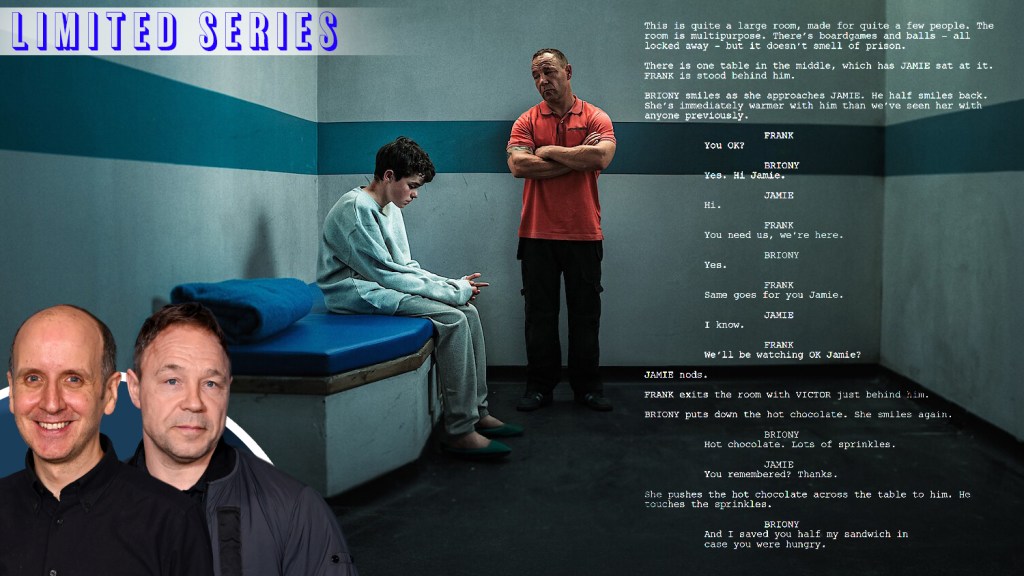
In their intro to the script for Episode 3 of their “whydunit” series, Thorne and Graham break down the idea behind each installment and explain why Part 3, in which Jamie is interviewed by forensic psychologist Briony Ariston (Erin Doherty), is the show’s “brain” or “bottle” episode. They discuss the inspirations for the episode’s play-style structure and its importance for testing the one-shot format as well as how the latter informed their writing.

(L-R) Stephen Graham and Jack Thorne
Getty Images
Because Adolescence was conceived as a ‘whydunnit’ rather than a ‘whodunnit’ our episodes worked by necessity in slightly different ways. Our motor was Jamie’s brain, who made it, how did they make it, why did he end up doing what he did? The series was a spider web of blame. We’d seen Jamie inside the criminal justice system in episode one as the facts of the case were partially established, we’d seen his school life in episode 2 and spent time with his friends and understood their online lives, in episode 4 we looked into his home life. Episode 3 was the brain episode. Let’s try and understand his synapses. Let’s hear the story from him.
The single shot was always part of the writing process. In episodes one and two that meant the scripts had to have some sense of control of the camera, always be finding it a story for it to travel with go with. If we were leaving one room to go into another, the camera had to have a pal to go with it. Stories became spinning plates which travelled from one character to another. In episode 3 that wasn’t such a concern, we were in a single room for most of it. This was our bottle episode. It was essentially a conversation.
The idea was to write it like a play – great playwright names were thrown around like such names were possible to emulate (they weren’t). David Mamet was mentioned more than once, and Oleanna was a huge inspiration. The script was structured in three acts. The first was tender, the second was truth telling, the final act was desperation. But the act lines had to disappear as the conversation caught the organic way that Jamie’s teenage brain structures burst thoughts through. Jamie’s anger had to be let out with small little turns of phrase, his truth was revealed not by him revealing it but by it tripping out of him. There were two things we kept returning to again and again (i) that Jamie is still horribly confused at what he’d done, not that he did it, he knows he did it, but why he did it (ii) Jamie has been alone in a place where he doesn’t have anyone to talk to so he really wants Briony to like him. The moment at the end where he asks her do you like me, is hopefully tender not just because of what it means for her, but because you see the child in him emerge just after the horror of what he’s done has been vomited out.
It was the first episode to be shot so a test of both our way of telling and our actors, particularly, of course, Owen Cooper. Sitting in rehearsals for that week was basically watching magic come to life. On the one hand there was Matt Lewis and Phil Barantini having to find a way to use a single lens to cover a single conversation. That was incredible. Conventionally conversations are covered in single takes on actors’ faces and then multiple two shots (from different angles) covering their interactions. Here Matt and Phil had to make the decision to give long periods of dialogue to one face or the other, experimenting through rehearsals as to which face gave more at key moments. In some ways it’s the single take at its purest (and best). On the other hand, there was Owen, who through the careful and brilliant direction of Phil and the remarkable generosity of the incredible Erin found a way to not just play Jamie but to inhabit him with tremendous soul. Within one week he became Robert De Niro. Watching him do so is one of the most thrilling experiences either of us has ever had on set.
Stephen Graham and Jack Thorne
Read the script below.
