

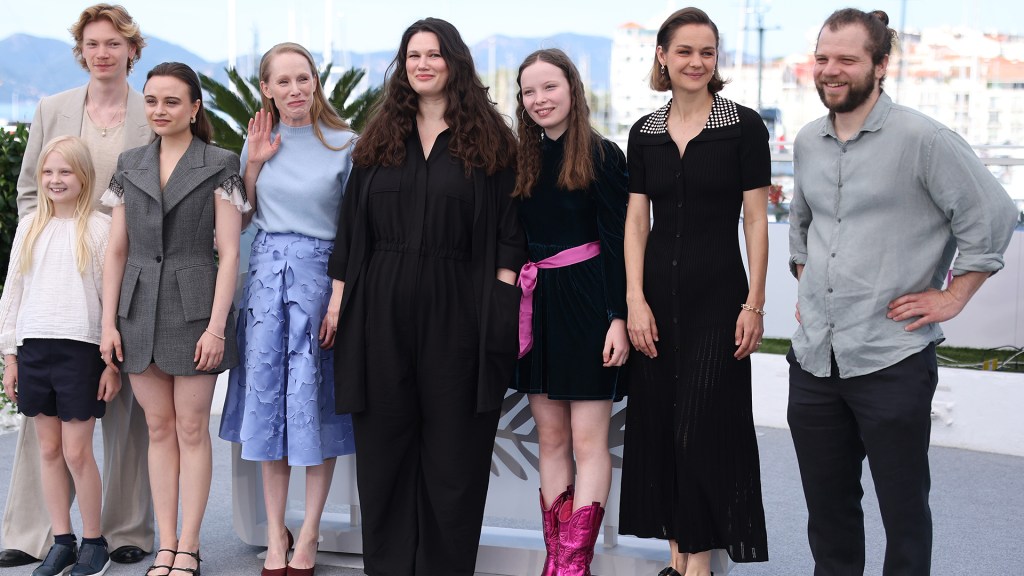
Despite a small turnout by press this morning for Cannes 78th’s first feature press conference, journos in the room gave Sound of Falling filmmaker Mascha Schilinski and cast a thunderous applause.
The wonder in Cannes are the titles we never see coming, which mushroom into must-haves for distribs, not to mention the entry of a fresh prolific cinematic voice on the global stage.
The German movie follows four girls during four different time periods –the 1910s, the 1940s, the 1980s, and our current day. The entire movie takes place on a German farm, and these young women’s lives are interconnected through time, space and generational trauma.
When it came to the inspiration for the movie which Deadline’s Damon Wise calls “an all-timer,” Schilinski and co-writer Louise Peter came across a photo from the 1920s of three women.
“It was a very modern photo. We got the impression these women were looking straight into our eyes. We felt the melancholy they suffered from in their past. We thought, let’s dig into their history,” said the filmmaker. Sound of Falling reps her sophomore directorial.
Originally the movie had a long working title, however, Schilinski and Peter settled on Sound of Falling.
“People fall from one era into another, some of the characters fall. It struck us as perfect,” said Schilinski.
“Several things happened in this place,” said Schilinski referring to the pic’s farm locale, ” We thought maybe someone is the room was using her Google phone, another woman lived in that room…we have this idea that trauma goes from one generation to the next. We don’t have access to these traumas any more, but something remains in people’s hearts.”
Is it possible for these protags to break free of generational trauma?
“We asked ourselves this very same question. We don’t think that it’s really the backdrop that plays a part. We looked into the traumas which could have occurred. When you talk about trauma that dates back to ancestry, it’s usually the War. But we weren’t interested in major events like war, but smaller ones, misfortunes, the feelings that sometimes have a tremendous impact on a character and that people don’t talk about it,” added the filmmaker.
Said actress Lena Urzendowsky who plays Angelika in the movie, “Mascha and Louise’s screenplay was sufficiently intelligent for us to feel what the other characters were going through. We had a connection to the place which transpired in our acting.”
Actress Susanne Wuest was greatly inspired by the box of photos which the filmmaker provided of the women who lived on the farm.
“When you see the film, there are ghosts that go both ways. I instinctively picked one up. I thought it was super spooky and scary. You can sense history and not be affected. A room can hold a history of a family,” said Wuest.
MK2 has world rights to the in-competition film, which Deadline’s Andreas Wiseman reports has spurred great interest from buyers.
