

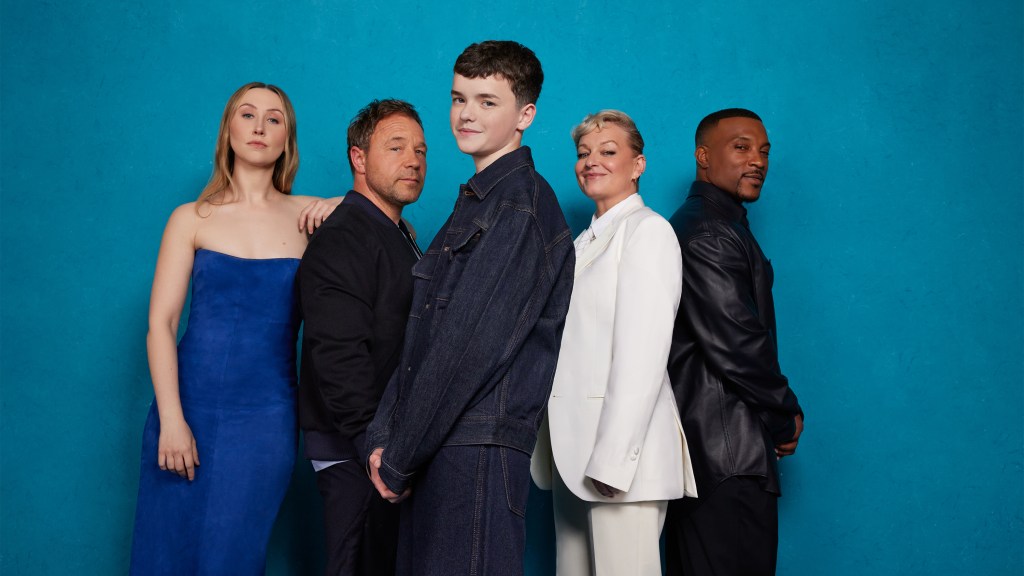
Stephen Graham, star and co-creator of Adolescence, finds it slightly trickier to do his weekly food shop since the four-part crime drama became one of the most-watched shows ever on Netflix.
“It’s dead hard getting round the Tesco these days,” he jokes, speaking two months after the show’s launch.
Adolescence tells the story of 13-year-old schoolboy Jamie Miller, played by Owen Cooper, who is arrested after the murder of his classmate Katie Leonard. The show, however, is not a whodunnit, that becomes clear early on in Episode 1, but rather, it asks the question: why? It’s a question that his family — dad, Eddie Miller, played by Graham, mum Manda, played by Christine Tremarco, and sister Lisa, played by Amélie Pease — are asking, as are detective inspector Luke Bascombe, played by Ashley Walters, and others, including therapist Briony Ariston, played by Erin Doherty.
“We thought it would just be a lovely little colloquial British story. You can see it’s made with love, compassion and respect and we served our story properly and stayed true to the subject that we’re covering. But, sometimes, those kinds of dramas obviously just resonate,” Graham says. “I’ve always tried to pick stuff that I do on television which can create conversations. This one, particularly, was a beautiful little stone. We threw it in the middle of a lake, and it caused a tsunami.”
It certainly made waves; the show recently became Netflix’s second most-watched English-language series of all time.
Some of the reasons it resonated are clear: it’s a powerful story about teenagers, one that hasn’t been widely told on TV, exploring how internet culture and certain bad actors are influencing youngsters; there are tremendous performances throughout, particularly by newcomer Cooper, who was only 13 when he won the role, and Graham.

(L-R) Graham and Miller
Violeta Sofia for Deadline
Then, there’s the incredible technical side to the show: all four episodes were filmed in a one-shot style, pioneered by director Philip Barantini, who had previously worked his magic on intense chef drama Boiling Point, and brought to life by cinematographer Matthew Lewis.
However, you wouldn’t expect that a four-part drama series, shot in South Yorkshire, and set near Warrington, between Liverpool and Manchester, started with a phone call from Brad Pitt’s production company Plan B Entertainment.
Jeremy Kleiner, who is co-president of Plan B, alongside Dede Gardner, had watched Boiling Point, the 2021 one-shot movie directed by Barantini and starring Graham, and called Barantini to discuss doing an eight-episode series in a similar fashion with the same team.
This was before Barantini and Graham, who had worked together as actors on HBO’s Band of Brothers, started working on a television spinoff of Boiling Point for the BBC. “They wanted to do something with me and Stephen with a one-take,” Barantini says.
Graham adds, “They pitched that idea to Phil and he mentioned it to me, but I said ‘I don’t really want to do [that eight-part series].’ I didn’t think it’d be interesting enough but I told him I had another idea. It was a moment of clarity.”
Graham and Barantini were “obsessed” with a British documentary series — 24 Hours in Police Custody, primarily following the Bedfordshire police, that has run for 11 seasons on Channel 4. Graham says that the idea for the story came to him like he was completing a children’s dot-to-dot book.
He had also come across a number of stories about young girls being stabbed to death by young boys (although not, as Elon Musk has suggested, the murder of three young girls at a Southport dance class, a crime that happened after Adolescence had wrapped).
It has nothing to do with culture, nothing to do with class. Something’s going on with the young lads that are asking for pictures of these girls.
Stephen Graham
“There were incidents like the young girl who got stabbed in Liverpool and other incidents that had just been infiltrating my mind. I remember being deeply saddened by each one of these situations. It wasn’t long before Christmas, I just remember thinking, what’s going on?” Graham says.
He was also influenced by two stories even closer to home involving the children and grandchildren of friends. One daughter, who went to an affluent private school, and one granddaughter who went to a comprehensive school, had been asked by their male classmates to send them naked pictures of themselves. The former did and they were shared widely at school.
Christine Tremarco
Violeta Sofia for Deadline
“I just thought that’s really f*cking strange. It has nothing to do with culture, nothing to do with class. Something’s going on with the young lads that are asking for pictures of these girls. I just thought that was really interesting as well, and when I had these little ideas for this patchwork quilt, I said, I’m going to ask Jack to write it,” he adds.
Graham had worked with Jack Thorne on six projects, including some made by one of Adolescence’s other production companies Warp Films, such as This Is England and The Virtues. Thorne is also the prodigious and prolific writer behind series such as HBO’s His Dark Materials, the Enola Holmes films and the Harry Potter and the Cursed Child stage play.
But Thorne didn’t immediately say yes. In fact, he challenged Graham to write the series with him.
“[Stephen] started talking about knife crime, and he talked about the things he’d seen, and he talked about four episodes. There was some flesh on the bones in terms of some things that he was interested in. Then we just talked and kept talking until there was a lot more flesh on the bones. Then we took it to Phil and tried to give it even more flesh on the bones,” Thorne says.
It’s not about not loving your kids, he feels like he’s been a good parent, but I think this is a wake-up call for him, and it was a wake-up call for me in my real life with my own kids
Ashley Walters
Thorne says Graham has “a soul a mile wide. He makes you all part of his mission in life. I always knew that he had this stuff that he needed to get out and that in his acting, he found ways to express it in all sorts of different ways. But I thought it would be really interesting to work with him as a writer. I knew he was shy about writing. I knew he was dyslexic. I knew that there were things that he would find difficult with it all, but he was brave enough to say, ‘Yeah, let’s give it a go,’ and so we just went from there.”
Barantini says Thorne’s initial script was like nothing else he’d ever read before. “It just hit me,” he says. “By the end of the episode, I was bawling my eyes out and I’d never done that with a script, and because I knew we were going to do it in one-take — that was the first spark of the whole thing — I was reading it with that in mind, picturing the camera moves and where we’re going to go. It was just this magical ride that I was on.”
The one-shot style also played in to how Graham and Thorne, with some help from the latter’s writing assistant Mariella Johnson, penned the series. The rule was essentially that the camera never goes anywhere without a story, or without a character to take them there.
“You write it in completely different way,” Thorne says. “It’s a completely different grammar to the way you normally write a show. It encouraged me to be a completely different writer, because normally you would try and tell a complete story with the audience [having] had the full experience and understood everything. With this, I’m going to take four big gasps of air, I’m going to blow out, and then at the end of it, they’re going to have some sense of the story, but we aren’t going to answer every question.”
Ashley Walters
Violeta Sofia for Deadline
He highlights the example of Episode 1, where a number of stories are told, such as Walters’ DI Bascombe and his partner, detective sergeant Misha Frank, played by Faye Marsay, leading a police raid into the Miller household to arrest Jamie, and then interviewing him alongside his father Eddie and his solicitor. None of the threads are fully explained in the moment.
In Episode 2, Bascombe is searching for the murder knife. Thorne says, “Normally, you’d find it, it’s Chekhov’s gun, right? You’ve got to answer it later on in the show, but that question is never answered. You never find out where the knife is because there’s no opportunity to. It would be inauthentic to suddenly… throw in a bit of exposition there.”
Thorne says he wanted to “celebrate the fact that this is incomplete” because that’s how life is, and credits Disney+’s WandaVision as one of the few TV shows that “challenged how you tell TV stories” for him. “I think the grammar of TV has become a bit tired. People are very used to certain answers done in certain ways. Actually, film is ahead of this, but TV is a little bit behind,” he adds.
Between Adolescence and Apple TV+’s The Studio, the oner (one-shot) is really having a moment. While Seth Rogen used his oner for laughs, Adolescence used it to heighten the drama and tell the four-part story through the eyes of a specific individual or individuals.
As a result, Barantini and DoP Lewis had to meticulously plan every element of the shoot, including finding a camera — in this case the Ronin 4D — that could easily fit through windows and be light enough to be passed to different crew, as well as plan the exact distance between specific locations such as the Miller’s home and the police station and the school and the murder site.
Each episode was made in three weeks; the first week was for rehearsals, the second week for the technical aspects and the third for filming. The plan for filming was to shoot two takes a day, allowing the team to have around 10 takes to ultimately choose from (although, as one would expect, this went up slightly with a few false starts).
For instance, the first episode used its second take, shot on the first day of shooting that block, the second episode, set in the frenetic environment of a school, with a cast of around 370 extras, was filmed in take 13, the third episode, essentially a bottle episode featuring almost exclusively Cooper and Doherty, was filmed 11 times, and the final episode, where the family are wrestling with what has happened over the last 13 months, used take number 16.
“When you do one-shot, it always has to serve the story, but it also has to serve the performances as well. Those two things have to come first, and the one-shot should be a subconscious thing that’s happening for the audience, it’s an extra feeling for them,” says Barantini.
But he adds that only certain kinds of actors react well to the oner. “There are a lot of fantastic actors out there who would potentially crumble at doing a one-shot. You have to find actors who are open to it, they listen, they feel it, they’re in the moment as opposed to coming on set and being like, ‘This is what I’m going to do in this moment’ or, ‘This is how I’m going to say this line.’ You need to find actors who can really be free with it, it’s important to let the actors feel that freedom.”
Episode 3, set in a youth detention center, was the first episode to be shot. It is almost entirely a conversation between Doherty’s forensic psychologist Briony Ariston, and Cooper’s Jamie, as she is preparing a pre-trial report on his mental capacity.
“It’s a game of tennis, and it’s important that these actors feel like they are able to really go there,” says Barantini. “It’s about giving them the confidence and the support. You’ve got to wrap your arms around these actors and go, ‘I’ve got you. You trust me, and I trust you, let’s see what happens.’ I think something really magical happens when you allow actors to do that.”
Erin Doherty
Violeta Sofia for Deadline
Doherty agrees, “You’d get to the end of shooting [the episode] and you just couldn’t really grasp what you’d just done, because you’ve got to completely surrender and just be present. Without sounding bizarre, you actually start believing you were doing it. It was the most freeing opportunity to shoot something that I’ve ever experienced. I’ll always treasure it because you don’t get it very often.”
Many have compared the shooting style to being in a play. Walters says it reminded him of being on stage. “That’s always a harrowing experience. I don’t care what actors tell you about how much they love it. It’s joyous when you’re on stage, but when you’re learning it before opening night and that curtain goes up, you’re absolutely sh*tting yourself. It was the same for me [on Adolescence]. But it was really a freeing experience. I wish you could shoot everything like that, you can’t obviously, but it definitely leveled up my craft,” he adds.
Walters says that when he first heard about it, the idea of a one-shot series sounded “fun” but that the reality didn’t hit him until he was on set. He was also nursing a bad back at the time.
“It just dawned on me, as we were rehearsing, that I’m kind of driving this first episode a lot of the time. It was struggling to sink in in the beginning, but that was because I was so anxious. Once I let go, I knew the words, it became a lot more fun, and I was raring to go,” he says.
Fatherhood is a key message in the series, and not just with Eddie and Jamie. In Episode 2, Bascombe’s son Adam, played by Amari Bacchus, helps his father decipher what certain emojis mean as he searches for a motive on the teens’ social media. Walters says that this moment reveals more than one would first assume. “The son has used it as a cry for help. It’s an opportunity for him to have something to talk to [his dad] about, that maybe he will be interested in. It’s not about not loving your kids, he feels like he’s been a good parent, but I think this is a wake-up call for him, and it was a wake-up call for me in my real life with my own kids,” he adds.
Doherty, who starred as the young Princess Anne in Seasons 3 and 4 of Netflix’s The Crown, is currently starring alongside Nicola Walker and Stephen Mangan in Mike Bartlett’s play Unicorn in London’s West End.
For her, Adolescence is “the perfect marriage of theater and the screen,” but, “it’s not like theater because the magic of theater is that you are in a room with people and you’re vibing off their energy and that dictates where the play goes. But this was different in the sense that, particularly for our episode, it was just me and Owen. There was something about our co-created energy. When you are on set normally, you’re so acutely aware of the boom operator, the sound guy, the props, but this just wasn’t that. I’ve just never experienced anything like it,” she adds.
The theater comparison is appropriate given that for the episode, Graham tasked Thorne with writing a David Mamet play. Another difference to normal sets was Thorne was present, particularly during rehearsals, so that if they needed to change a line, they could do that up top, as there’d be no reshoots.
(L-R) Cooper, Graham and Walters
Violeta Sofia for Deadline
Episode 3 was also the first scene that Cooper had ever filmed, a remarkable feat for anyone, let alone a teenager fresh from drama club.
“I didn’t know what was hard and what was easy, so I just went with it,” he says. “I didn’t know any better to do the one-shot and do all those lines. Whatever I got asked to do, I did it because I wanted to prove that I was right for the part of Jamie, I wanted to impress everyone. I went in there knowing my lines, which I didn’t think I’d be able to do.”
Our layers of improv were just, they were working their minds of their own, because me and Owen didn’t even remember I said that. That’s where we got to, which is insane
Erin Doherty
Cooper also reveals that something that Barantini said to him in the audition process might have been the reason he was off book from the start, something not all of the actors could say. “Phil brought me to his office and said, ‘It’s going to be shot in this one-take thing where there’s no cuts. So, if you get a line wrong, then you’re going to have to go to the very beginning.’ I don’t know why he said it that way, but it scared me a lot. I didn’t want to be the person that restarted it and I’m very happy I wasn’t,” he says.
There’s a moment in the episode, where Cooper yawns, which was not in the script, and Doherty comes back with a perfect line.
“I wouldn’t have been able to [do this episode] with just any actor. Anything I’d say, she would be able to come back with something you wouldn’t expect. When I yawned, she then said, ‘Am I boring you?’ It was just a natural yawn. It was on Friday, the last day shooting and it was the last take so I was very tired,” he says.
Doherty adds, “He was genuinely exhausted. In a weird way he was saying it just happened. And then in a weird way, for me, I couldn’t not respond. That was the joy of where we got to. We were genuinely both just so entwined. Our layers of improv were just, they were working their minds of their own, because me and Owen didn’t even remember I said that. That’s where we got to, which is insane.”
I do feel like I had a lot of Jamie in me when I was that age, and I was that confused about the world and about my relationship with the world, and about whether I would ever be liked, actually, whether I would ever have friends.
Jack Thorne, writer
Hannah Walters, who runs Matriarch Productions with (her husband) Graham and is an executive producer of the show, calls it a “chess match” between Cooper and Doherty.
It’s a chess battle that is essentially about power. Briony is trying to understand Jamie’s motivations and the boy veers between emotional moments, asking whether she likes him; anger, most notably in a terrifying scene when he knocks over a chair; and a strange sense that he’s not as bad as other kids. (“I could have touched her, but I didn’t. Most boys would. So, that makes me better.”)
How on earth did 46-year-old Thorne get inside Jamie’s head like that? “Probably easier than I would like. I do feel like I had a lot of Jamie in me when I was that age, and I was that confused about the world and about my relationship with the world, and about whether I would ever be liked, actually, whether I would ever have friends. That’s how I sort of saw the world, as this great morass of unfriendly faces.”
Thorne explains that, in the episode, Jamie doesn’t understand what he did. He knows what he did but doesn’t really understand why he did it. He’s also trying to hide it because he likes Briony. “He’s in a place where he can’t talk to anyone and suddenly there’s this interesting person that comes and talks to him and makes him feel like a human being for an hour,” he adds.
Briony is also showing generosity towards Jamie, as evidenced by a cheese and pickle sandwich, a packaged lunch that has fascinated the internet.
Cooper and Doherty
Violeta Sofia for Deadline
Two months after the show aired, Barantini texted Thorne to ask, “What does this f*cking sandwich mean because everyone’s asking me?” Thorne laughs when he recounts this story, because, he says, “The sandwiches don’t mean anything. She saved half her lunch so that she could start this relationship in this final interview with a tender act of generosity, in the same way that she’s brought a little bag of marshmallows to put in the hot chocolate. She is aware of what he needs, which is comfort, and she offers him comfort.”
Now, Thorne says to Barantini, “We went through the whole shooting process. I would have told you if it meant anything. I hate metaphors.”
A similar item also sent some down an internet rabbit hole: the wallpaper in Jamie’s bedroom. Some viewers took to Reddit to question if the murder knife is stashed behind the wallpaper in his room. “That makes me laugh because that was me saying to Adam [Tomlinson], our production designer, ‘Do you remember when you were a kid and you would rip the wallpaper by the side of your bed?’ That’s what that was,” says Barantini.
Thorne says he’s really “grateful” that people are taking such an interest in such details. “I’ve craved this sort of attention on something I’ve written my entire writing life. There have been details of stuff that I’ve written where I’ve wished people had noticed.”
Cooper’s remarkable performance is even more astonishing when you find out that Adolescence was his first ever audition, having previously attempted to audition for ITV soap Coronation Street. He spent a couple of years doing drama club before sending in a self-tape for Adolescence that landed him an audition in Manchester and five more chances to impress and beat out a number of other boys (all of whom got to appear in the show in Episode 2’s school scene). He reveals it was the chemistry test with Graham that was his favorite part of that audition process.
“Me and Stephen, we just clicked straight away. It was weird, but it just happened,” he says.
Cooper learned that he got the part when he returned home from school one day and his mum revealed the news. “It was a relief because there were so many nerves going into it. I wanted Jamie. I wanted that part so badly so to finally hear, it was amazing,”he says.
Graham brings it back to when he starred in This Is England, Shane Meadows’ 2006 movie about young skinheads set in 1983, and he met the film’s star Thomas Turgoose, who was a similar age to Cooper when they started.
“When I was fortunate enough to be part of This Is England, that was a breakout role [for me]. But to work with Thomas Turgoose and what El Tomo brought was just pure authenticity, unadulterated talent, fresh and unique. It’s something I thought I’d never see again,” says Graham. “When [Cooper and I] were in that room I just looked at him and said, ‘I’m going to be your dad,’ and he went ‘OK’ and I just felt something then. He just had this magic.”
(L-R) Graham, director Philip Barantini and cinematographer Matthew Lewis on the set of ‘Adolescence’
Ben Blackall/Netflix
Barantini admits that the whole team was nervous about casting a 13-year-old, particularly because of the subject matter and the workload. They considered casting someone older but decided against it. Casting director Shaheen Baig looked at more than 500 boys during the process.
“We saw a lot of kids,” Barantini says. “When you’re auditioning people like that, you’ve got to take it slowly. We knew that this was going to be a bit of a process. Shaheen is amazing at finding new talents. Owen was quite early on. He had the screen test with Stephen and something about Owen was just so real and natural. Everything I threw at him, he would just take. On day one, he turned up with no script and he was like, ‘I’ve learned it.’ Sure enough, he was completely off book and at that moment I knew we were going to be alright.”
It turns out they were alright.
Graham has compared Cooper to Robert De Niro, who he worked with on Netflix’s The Irishman. In a serendipitous moment, Graham, Cooper and De Niro all appeared on BBC talk show The One Show in March as De Niro was promoting The Alto Knights. “I told Bob about Owen and he touched Owen’s knee and gave him this lovely smile. He was so lovely with him and Owen’s got this signed Taxi Driver poster from him too,” Graham says.
While much has been made of the technical aspects of filming Adolescence, many of the actors praised the emotional side of Barantini’s directing, particularly with Cooper. “One of the beautiful things about Phil as a director is he’s very collaborative and he allows there to be a really beautiful space and place for us to be able to find it as a collective. He never tells you what to do but he points you in the possible direction to go. Maybe that comes from the fact that he was an actor, and he understands a lot about it in that respect, and what it takes to get to certain places,” says Graham.
It takes a village to raise a child. There’s a responsibility and we are all accountable. Maybe the school is responsible, to an extent, society in general, the community, the family, of course. Then on top of that, today we have what we didn’t have, but the internet can educate and parent our kids just as much as we did.
Stephen Graham
Thorne adds, “He does create this incredible atmosphere. It was like being on holiday on that show. He’s one of the most musical directors I’ve ever worked with in terms of how he deals with actors, but also how he deals with scripts. That first week with Owen was like nothing else I’ve experienced in terms of the delicate work he did.”
Barantini, who is currently shooting Enola Holmes 3, is also aware that he doesn’t want his one-shot to become a “gimmick.”
In Adolescence, it’s never a gimmick, as highlighted by its devastating use in the fourth and final episode as Graham’s Eddie and his wife and daughter drive to local hardware store Wainwrights after his van is graffitied with the word ‘Nonse’ — a moment, soundtracked by Aha’s “Take on Me”, where they’re trying to get their day (and life) back.
Christine Tremarco, who plays Manda, has known Graham since they were kids in Kirby. She jokes that the “nanna dancing” in the van wasn’t in the script.
But a call from Jamie in prison to let them know he’s changing his plea changes the mood. As the family returns home, Eddie and Manda have a seismic heart-to-heart.
Cooper as Jamie Miller in ‘Adolescence’
Ben Blackall/Netflix
“[Manda] is trying to keep it together; she’s trying to stay strong. From Episode 1, when the police burst in and take her baby out of their home and put him a police cell, it’s horrifying. She breaks, obviously, towards the end of Episode 4 but then she still pulls it back in. She’s trying to keep her family together,” she says.
A story about young, male rage is exemplified in these moments and one can’t help but think of Andrew Tate, who faces 10 charges of rape, actual bodily harm, human trafficking, and controlling prostitution for gain in the U.K., and how the manosphere, particularly online, has influenced these boys.
“He never left his room. He’d come home, slam the door, straight up the stairs, on the computer,” Manda says.
“It takes a village to raise a child,” says Graham. “There’s a responsibility and we are all accountable. Maybe the school is responsible, to an extent, society in general, the community, the family, of course. Then on top of that, today we have what we didn’t have, but the internet can educate and parent our kids just as much as we did.”
Cooper himself says he wasn’t even aware of the issue. “I am so glad I didn’t know about any of that. Me and my friends hadn’t come across the manosphere and the dark stuff. It definitely is happening, which is shocking, and obviously knife crime, I’ve been told about those since like year five.”
“I am so glad I didn’t know about any of that. Me and my friends hadn’t come across the manosphere and the dark stuff.
Owen Cooper
In the closing moments, Eddie, Manda and Lisa have a sweet moment on the stairs before Eddie says, ‘How did we make her?’ and Manda replies, ‘Same way we made him.’
Graham says they condensed that scene. “I remember it being such a beautiful moment.” Eddie then goes into Jamie’s room to grieve and apologizes that he “should have done better”.
To achieve this heartbreaking moment, Barantini and Hannah Walters, surrounded by her and Graham’s children Grace and Alfie, surprised Graham. “My wife, what she’s done is she got some photographs of me and them when they were kids and put them all over the wardrobe, and they’d go, ‘We love you, dad. We’re so proud of you.’ I just looked at it for a second, and I just went,” he says.
It was a fitting end to the show. What nobody expected was the reaction.
Cooper, who is starring alongside Jacob Elordi and Margot Robbie as Young Heathcliff in the upcoming feature adaptation of Wuthering Heights, has his mock exams coming up and is lucky to have friends that aren’t overdoing it.
“Well done is the best compliment I’ve got off my mates. I’m glad they’re not overreacting,” Cooper says. “I’ve been trying as hard as possible to have a normal life. It’s just been a lot busier than normal. I’ve been waiting so long for the show to come out, and now it’s finally out. I wasn’t expecting such a big response. I don’t think anyone was really.”
There’s been talk of another project between Graham, Barantini, Thorne and production companies including Plan B. But more than anything, Adolescence has given Graham the self-assurance to get more stories out of his head.
“Being a part of that creative process, I think it has given me confidence to be able to have communication and conversations with directors and writers about what is the truth? What are we trying to get to? What is the truth that we’re telling here. It’s something I really enjoyed, and I hope it’s something that I do again.”
(L-R) British Prime Minister Keir Starmer, hosts a roundtable meeting with ‘Adolescence’ writer Jack Thorne
Jack Taylor/Getty Images
How Netflix’s Local Strategy led to the “Lightning Strike” of ‘Adolescence’
The number of people who have watched Adolescence is staggering; the drama just became Netflix’s second most-watched English-language series of all time after the first season of Wednesday, overtaking the fourth season of Stranger Things and Monster: The Jeffrey Dahmer Story and making U.K. TV history as the first streaming series to top Britain’s weekly ratings chart.
It also made U.K. TV history after becoming the first streaming series to top Britain’s weekly TV ratings. Per BARB (Broadcasters Audience Research Board), the first episode of Adolescence was watched by 6.45M, more than the number that tuned in to watch The Apprentice or Death in Paradise, which both air on the BBC. Thorne was also invited to Downing Street after Prime Minister Kier Starmer praised the show, saying it “hit home hard”, and it would be available to watch in schools across Britain.
“It’s testament to the fact that there’s no substitute to a really great story that’s passionately told by a group of talented people. That’s the most gratifying thing, and the thing I take most pride in is that it has resonated and has managed to break on to that [chart]. It’s the power of storytelling,” says Mona Qureshi, Netflix’s director of U.K. content.
Former BBC executive Qureshi joined Netflix in spring 2022. When she joined the team run by former Sky drama chief Anne Mensah, she says that the strategy was “very much local for local content. There was a real focus on finding shows that would really resonate first and foremost with the U.K. audience,” she says.
But Adolescence would not be on the horizon for at least 18 months. In fact, it was another show written by Jack Thorne — Toxic Town — that would be Netflix’s first British drama that would carry on the legacy of British kitchen sink realism that started in the late 1950s. Britain has a solid history of socially realistic TV series, from Alan Bleasdale’s 1982 series Boys from the Blackstuff to Franc Roddam’s Auf Wiedersehen, Pet, Hanif Kureishi’s 1991 series The Buddha of Suburbia, Peter Flannery’s Our Friends in the North, which kickstarted the career of Daniel Craig, and more recently Toby Jones-led Mr. Bates vs. The Post Office.
It’s testament to the fact that there’s no substitute to a really great story that’s passionately told by a group of talented people. That’s the most gratifying thing, and the thing I take most pride in is that it has resonated. It’s the power of storytelling
Mona Qureshi, Netflix’s director of U.K. content
Toxic Town, written by Thorne, premiered just two weeks before Adolescence. The four-part series told the story of three mothers involved in the Corby toxic waste poisonings, which resulted in a number of women in the Midlands town giving birth to disabled babies, and the subsequent court case. It had a starry cast with the likes of Doctor Who’s Jodie Whittaker, The White Lotus’ Aimee Lou Wood, The Full Monty’s Robert Carlyle and The Diplomat’s Rory Kinnear, and was produced by Black Mirror duo Charlie Brooker and Annabel Jones.
“Toxic Town also did really well for us. Adolescence is incredible, and we all love that adolescent, but characteristic to its name, it has outshone everything. It’s sort of taken up the conversation. Yes, it’s within the tradition of social drama, the British audience loves shows where there’s triumph against adversity and a cause at the heart of it,” Qureshi says.
Shortly after Toxic Town started production, Thorne and his partners brought Qureshi and her team another four-part drama that would hit the nerve of even more everyday people.
Cooper and Doherty with the famous cheese and pickle sandwich
Ben Blackall/Netflix
Qureshi had worked with Philip Barantini on BBC crime drama The Responder with Barantini directing the final episode of Season 1 as well as having a recurring role on the show. Barantini had already made Boiling Point, a short that later turned into feature starring Stephen Graham, and Qureshi had suggested turning the chef drama into a series. However, she never got the chance to work on it because she was “pinched by Netflix,” joking that she had “unfinished business” with Barantini.
That unfinished business turned out to be Adolescence, which had previously been in development at Amazon but was ultimately turned down by Jen Salke, who, coincidentally, left the streamer two weeks after it launched on Netflix.
“The whole team came in around Christmas 2023 and they had a script that that they left Anne [Mensah] and I with. They told us about it in the room and then we went away, read that script in one gulp, and instantly knew it was something,” she adds.
It turned out it was truly something. Qureshi recalls reading the script for the first episode. “From the very first scenes with DI Bascombe (Ashley Walters), where initially it was here’s this guy who’s trying to do a job… but his kid’s calling him and trying to take a sickie. We can all relate to that and that’s just the beginning of the day. Then you go through the door into that experience with Eddie (Graham) and Manda (Christine Tremarco), and suddenly your heart’s in your mouth, because you really felt in that script, ‘Why are they coming after my kid?’ You travel with that emotion all the way through everything that Eddie and Manda experience and then to that awful rug-pull of a moment where they reveal the CCTV,” she says.
Because of the way that the show was filmed, there was not much opportunity to give notes in the edit, but she says she watched a lot of takes. “From the very beginning, much like the script, we would watch it and say to each other, ‘This is amazing.’ It blew you away, you felt it every time.”
Read the digital edition of Deadline’s Emmy Preview magazine here.
She knew audiences would agree. “There’s so much content, I think our palates have become so sophisticated and [one] can sniff a bum note, we can sniff authenticity. Adolescence is the best example of that. You come to it as a parent, you come to it as a woman, you come to it as a grandparent to a child who’s concerned about these things, and you feel you’re inside the lives of those people. Beyond the incredible bravura filmmaking, that’s what’s really special about it and that needs to be celebrated. For me, it’s raised the bar on how we should be doing and championing shows like that,” she adds.
Qureshi, who is also involved in upcoming series such as the Dolly Alderton-penned adaptation of Pride and Prejudice starring Emma Corrin and Olivia Colman, wants a drama slate with “breadth and range,” she says. “We’re looking to speak with specificity to one person. We’re thinking about who that audience is and making sure we can reach as many of them and cater to as many of those tastes and that diversity as we can. It’s as simple and as complicated as that. We’re absolutely about the next Toxic Town as much as we are the next lightning strike.”
