

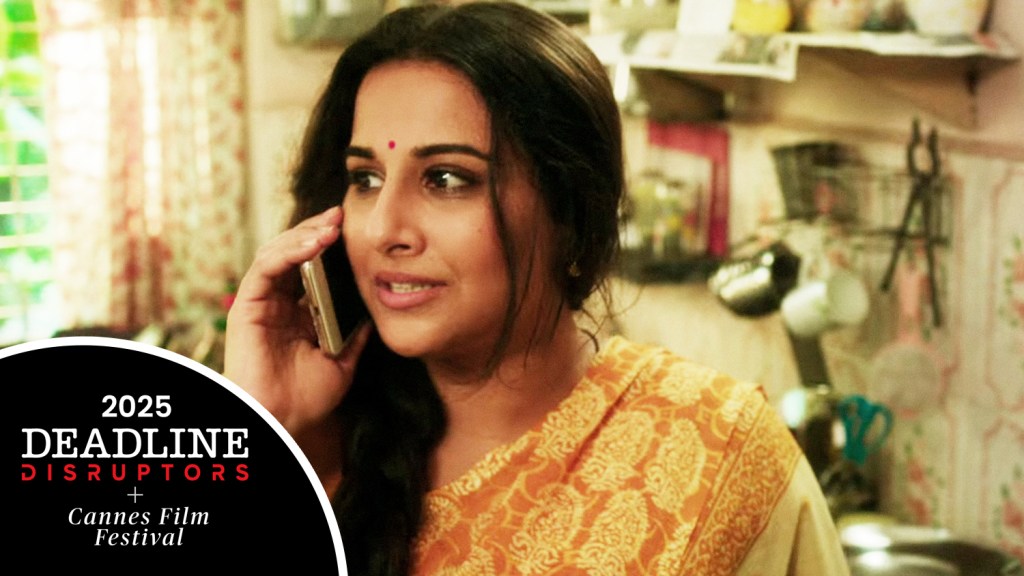
Vidya Balan has long been a pioneer in Hindi Cinema — or Bollywood as it’s more often called — inciting change in the portrayal of women through her mold-breaking leading roles.
“Generally in Hindi cinema, women characters are not very layered, robbing them of their humanity,” says Balan.
Last year, she reprised her iconic character of Manjulika in the horror comedy Bhool Bhulaiyaa 3 — which became the second-highest grossing Hindi film of 2024, earning around $50 million. Balan’s Manjulika, a 19th century royal court dancer who returns as an unforgiving spirit to avenge her murder, strikes a balance between fragility and fury. The character is a powerful metaphor of oppressed women, challenging patriarchal norms, and has emerged as a symbol of female strength and resilience within the Indian horror genre.

Vidya Balan
Courtesy of Idhyah
Among Balan’s other successful films boasting lead female characters: The Dirty Picture, inspired by the life of South Indian actress Silk Smitha, who defied the norm in the ’80s doing sexually driven roles. Balan, who played Smitha, received wide acclaim as one of the boldest female performances in the history of Indian cinema; and Kahaani, which explored the impact of grief, the transformative power of trauma, and complexities of revenge. Balan’s character in Kahaani, Vidya Bagchi, is represented as the female hero who is portrayed, in parallel, as the all-powerful Goddess Durga of the Hindu pantheon.
RELATED: ‘The Phoenician Scheme’ Cannes Red Carpet Photos: Wes Anderson, Mia Threapleton, Benicio del Toro, Bill Murray, Michael Cera, & More
Back when she was first starting out in Bollywood, there was no clear path for Balan to find the compelling roles she wanted, because those kinds of female characters were simply not being written.
“There was no question of strategizing [to play strong characters] because one had never really seen women take center stage in mainstream films,” she says. “The few films that I enjoyed where women were leading the story were in art house cinema. The only film I can think of which was commercially viable and led by a woman was Chaalbaaz” — a 1989 film starring the well-known actress Sridevi in dual leading roles.
RELATED: ‘Bono: Stories Of Surrender’: On Irish Fathers & Sons, Processing Family Tragedy & How A Need To Be Heard Propelled A Dublin Kid To Become One Of The World’s Biggest Rock Stars
Balan wanted to find a way to bring central female characters more into the mainstream of Hindi cinema. But she “never imagined that it was actually possible.”
But then came her debut in Parineeta, with her role based on a well-rounded character in a popular novella. The film was a critical and commercial hit, so Balan had proven a commercial Bollywood film could have a compelling woman as a central character. She was now in a position to push for engaging, nuanced roles for herself, even if those hadn’t been widely available to actresses before. “I began getting roles with some amount of sense, even within regular mainstream films,” Balan says.
She went on to play a single mother grappling to raise a 12-year-old son in Paa; a seductive, manipulative widow in Ishqiya; the titular role in Shakuntala Devi; and an ambitious housewife who becomes a radio jockey for a late-night relationship advice show in Tumhari Sulu.
RELATED: Ooh-La-La Land: Everything You Always Wanted To Know About Sex* (*And The Cannes Film Festival)
“In each of these films, there was an opportunity for me to do something different as an actor,” says Balan. “They were well fleshed-out characters, and yet they were great scripts and very engaging, entertaining films.”
Read the digital edition of Deadline’s Disruptors/Cannes magazine here.
As winner of the Indian National Film Award and seven Filmfare Awards, Balan’s star power has expanded globally. She served on the 2013 Cannes Film Festival jury and became a member of the Academy of Motion Picture Arts and Sciences in 2021. And these days, she’s looking for new and juicy roles on a global scale too. “I’d love to play [a character like] the therapist in Adolescence. That’s on the top of my mind at this point,” she says. “I would love to do comedy. I absolutely loved Kate Winslet in The Regime. I also love the work Nicole Kidman and Reese Witherspoon are doing.”
But in India, after almost two decades of reimagining female roles, Balan feels that more change is definitely needed in terms of gender equality in cinema, and that the financial pinch created by Covid has set things back somewhat. “Post-pandemic, people in India have lost the habit of going to the theaters to watch films,” she says. “The studios feel it would be safer to bet on the historically male-led films. In my opinion, this calls for a reinvention in the female-led film space.”
